






Should Transformer Coils Have External Insulation Wrapping?
Should Transformer Coils Have External Insulation Wrapping?
In the global power and industrial sectors, transformer reliability is the cornerstone of value. Operators and designers consistently face a core engineering trade-off: Should external insulation wrapping be added to transformer coils? This decision directly impacts the two vital lifelines of the equipment: insulation reliability and cooling efficiency.
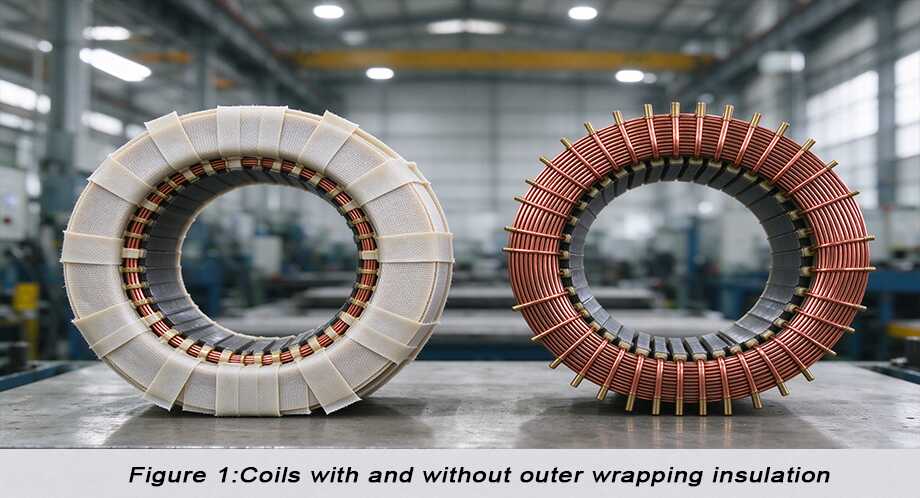
1. The Core Conflict: The Physics of Enhanced Insulation vs. Impaired Heat Dissipation
External insulation wrapping, which involves covering the windings with materials like polyester film or aramid paper, is initially intended to improve electrical safety. However, all insulating materials are poor conductors of heat. This creates a fundamental physical conflict:
1.1 The Insulation Requirement Demands a “Thicker” Barrier:
According to the electric field strength formula
E = V / d
where E is the field strength
V is the voltage
d is the insulation distance.
In areas with high voltage or sharp electric field concentrations, increasing the insulation thickness d is the most direct method to reduce the electric field strength E, preventing partial discharge and electrical breakdown. External insulation plays a key role here. It reinforces the main insulation between coils and to ground, and provides a safety margin against overvoltages, such as lightning strikes.
1.2 The Cooling Requirement Demands “Fewer” Barriers:
Transformer temperature rise originates from winding losses (copper loss). Heat must transfer from inside the copper conductor to its surface, and then be carried away by the cooling medium (oil or air). According to the basic law of heat conduction
Q = k * A * ΔT / d
where k is the thermal conductivity
A is the area
ΔT is the temperature difference
d is the thickness
Adding external insulation introduces an additional thermal resistance with a very low thermal conductivity k (typically 0.1-0.3 W/m·K) and a non-negligible thickness d. This directly impedes the outflow of heat Q, potentially leading to increased winding hot-spot temperatures. This, in turn, can accelerate the thermal aging of the insulation material, creating a vicious cycle.
In simple terms, every layer added for insulation’s sake may subtract from cooling efficiency. Determining whether external insulation is needed essentially boils down to evaluating, for a specific application, whether the insulation gain outweighs the thermal cost.
2. The Path Forward: Three Strategies for Synergistic Optimization of Cooling and Insulation
Modern transformer design has moved beyond simple “trade-off” thinking. It now seeks synergistic optimization through innovations in materials science and design engineering.
2.1 Strategy One:
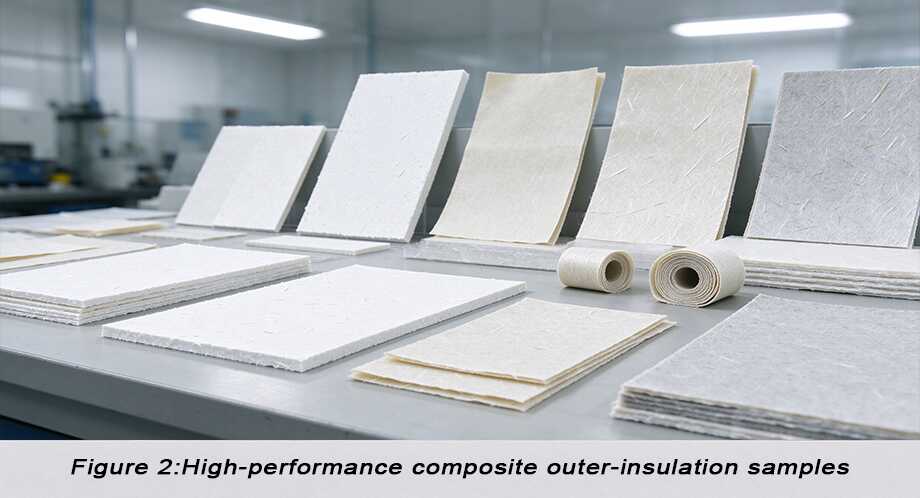
Adopting High-Performance Composite Materials to Redefine Material Boundaries Traditional insulation materials often force a compromise between thermal conductivity and insulating properties. The current technological frontier involves developing and applying functional composite materials.
(1)Principle: High thermal conductivity but electrically insulating nano- or micro-scale fillers (such as boron nitride or aluminum oxide) are directionally added to a polymer matrix (like epoxy resin or polyimide). These fillers create localized “thermal pathways,” significantly increasing the material’s overall thermal conductivity k, while their own excellent insulating properties maintain the material’s dielectric strength.
(2)Effect: Using such materials for external insulation allows for better heat dissipation capability at an equivalent insulation level, or more reliable insulation protection while maintaining the same temperature rise. This directly addresses key technical challenges like dry type transformer temperature rise control and high power density transformer design.
2.2 Strategy Two: Integrating the Insulation Layer into the Overall
Thermal Management System Design The most advanced design philosophy views the insulation layer as an integral, functional component of the cooling system.
2.3 Principle and Case Studies:
(1)Oil-Immersed Transformers:
Guide channels or corrugations can be pre-formed on the external insulation wrapping. These structures not only provide the necessary insulation distance but, more importantly, they direct the flow path of the transformer oil. This transforms chaotic oil flow into a directed, highly efficient cooling stream that actively scrubs and carries away heat. This explains why complex insulation component shapes in large power transformers are the result of precise fluid dynamics and thermodynamic calculations.
(2)Dry-Type Transformers:
The Vacuum Pressure Impregnation (VPI) process is used, where the entire winding is impregnated with materials like epoxy resin. Here, the external insulation and the filling medium merge into one, forming a solid and sealed “armor.” Although the thermal conductivity of the resin itself may be moderate, this process completely eliminates internal air gaps (which are excellent thermal barriers). (integrating closely) with external cooling ducts, it establishes a holistic, efficient thermal pathway from the copper conductor to the external environment.
Conclusion
The answer to “Should transformer coils have external insulation wrapping?” has evolved from a simple process choice into a systematic optimization challenge involving materials science, electromagnetics, thermodynamics, and engineering economics. Under the global industry trend pursuing higher efficiency, smaller size, and extreme reliability, the key lies in shifting from an “adversarial mindset” to a “synergistic mindset.” Through precise simulation, material innovation, and integrated design, the insulation system can become a contributor to thermal management, ensuring optimal performance for both transformer coil insulation and overall thermal management in transformers.
Contact
LuShan, est. 1975, is a Chinese professional manufacturer specializing in power transformers and reactors for 50+ years. Leading products are single-phase transformer, three-phase isolation transformers, electrical transformer, distribution transformer, step down and step up transformer, low voltage transformer, high voltage transformer, control transformer, toroidal transformer, R-core transformer; DC inductors, AC reactors, filtering reactor, line and load reactor, chokes, filtering reactor, and intermediate, high-frequency products.
Our power transformers and reactors are widely used in 10 application areas: rapid transit, construction machinery, renewable energy, intelligent manufacturing, medical equipment, coal mine explosion prevention, excitation system, vacuum sintering(furnace), central air conditioning.
Know more about power transformer and reactor: www.lstransformer.com.
If you would like to obtain customized solutions for transformers or reactors, please contact us.
WhatsApp:+86 13787095096
Email: marketing@hnlsdz.com

