
 EN
EN
 FR
FR DE
DE ES
ES
Oil-Immersed Transformers vs. Dry-Type Transformers: A Deep Technical Analysis of Lead Sealing Processes
Oil-Immersed Transformers vs. Dry-Type Transformers: A Deep Technical Analysis of Lead Sealing Processes
Transformers are the core equipment of power systems, and the sealing process of their leads directly impacts the reliability and safety of operation. This article provides an in-depth analysis of the fundamental differences in lead sealing processes between oil-immersed and dry-type transformers, offering a professional interpretation from multiple dimensions, including materials science, structural design, and process standards.
Content
1. Engineering Implementation of Lead Sealing in Oil-Immersed Transformers
● Hierarchical Structure of the Sealing System
The lead sealing in oil-immersed transformers is a typical composite sealing system, consisting of three critical layers:
(1)Primary Sealing Layer:High-density nitrile rubber (NBR) O-rings with a Shore hardness of 70±5, ensuring elasticity within a working temperature range of -40°C to 120°C.
(2)Secondary Sealing Layer: Metal spiral wound gaskets, typically made of 304 stainless steel strips interleaved with flexible graphite, with a compression rate maintained at 18%-22%.
(3)Ultimate Sealing Layer:A spring-loaded mechanical sealing device with a preload force designed at 1.5 times the operating pressure.
This three-tier sealing structure complies with the Class B sealing requirements of the ASME PCC-1 standard, ensuring a leakage rate of less than 5 ppm under 0.5 MPa oil pressure for 10 years.
● Scientific Material Selection
The performance evaluation of sealing materials for oil-immersed transformers uses the Arrhenius accelerated aging model:
Aging rate constant k = A·e^(-Ea/RT)
Where:
A: Pre-exponential factor (material constant)
Ea: Activation energy (kJ/mol)
R: Ideal gas constant (8.314 J/mol·K)
T: Absolute temperature (K)
Experimental data show that fluorocarbon rubber (FKM) has an Ea value of 85 kJ/mol in transformer oil, significantly outperforming nitrile rubber (65 kJ/mol), which is why FKM is preferred for high-end transformers.
● Key Process Control Parameters
The sealing process for oil-immersed transformers requires strict control of the following parameters:
Process Parameter | Control Range | Testing Method |
Flange Flatness | ≤0.05 mm/m | Laser Flatness Tester |
Surface Roughness | Ra 3.2-6.3 μm | Contact Profilometer |
Bolt Preload Force | ±5% of Design Value | Hydraulic Torque Wrench |
Thermal Cycles | 5 cycles (-30°C to 100°C) | Environmental Test Chamber |
According to the IEC 60544-2 standard, the sealing system must pass a minimum of 1,000 hours of hot oil aging testing (110°C), with performance degradation not exceeding 20% of the initial value.
2. Technological Breakthroughs in Dry-Type Transformer Lead Sealing
● Molecular-Level Sealing with Epoxy Resin Casting
Modern dry-type transformers use nano-modified epoxy resin systems, with the curing process following the Kamal kinetic model:
dα/dt = (k1 + k2α^m)(1-α)^n
Where:
α: Degree of curing (0-1)
k1, k2: Reaction rate constants
m, n: Reaction orders
Nuclear magnetic resonance (NMR) monitoring reveals the optimal curing process:
(1)Stepwise Heating: 50°C (2h) → 80°C (4h) → 110°C (6h)
(2)Vacuum Control: ≤50 Pa
(3)Curing Agent Ratio:EP862 Resin : Methyltetrahydrophthalic Anhydride = 100:85 (by weight)
This process ensures a resin volume shrinkage rate below 0.3%, preventing cracks caused by internal stress.
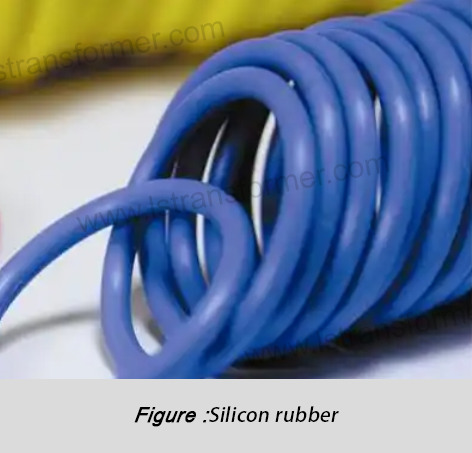
● Interface Engineering with Silicone Rubber Sealing
Low-voltage leads in dry-type transformers use specially formulated silicone rubber sealing, with key technologies including:
(1)Surface Treatment:Plasma activation (300W, 90s) increases copper conductor surface energy to 72 mN/m.
(2)Adhesive System:γ-Aminopropyltriethoxysilane (KH-550) is used as a coupling agent at 1.5 wt% of the silicone rubber.
(3)Elastic Modulus:Reinforced with silica to achieve a final product modulus of 3-5 MPa.
Test data show that this sealing system retains over 85% of its initial interfacial bond strength after 1,000 hours in an 85°C/85% RH environment.
3. Technical Comparison and Engineering Selection Guide
● Quantitative Comparison of Sealing Performance
Performance Metric | Oil-Immersed Transformer | Dry-Type Transformer | Testing Standard |
Leakage Rate | <5×10⁻⁶ Pa·m³/s | N/A | ISO 15848 |
Moisture Permeability | <0.1 g/m²·day | <0.01 g/m²·day | ASTM E96 |
Temperature Range | -40°C to 120°C | -50°C to 180°C | IEC 60068 |
UV Resistance | Poor | Excellent (Grade 5) | ASTM G154 |
● Decision Model for Engineering Selection
A weighted scoring method is recommended:
Total Score = 0.3×Weather Resistance + 0.25×Maintainability + 0.2×Cost + 0.15×Safety + 0.1×Environmental Impact
Where:
(1)Oil-immersed transformers score higher in maintainability and cost.
(2)Dry-type transformers excel in weather resistance, safety, and environmental impact.
According to IEEE C57.12.00, dry-type transformers should be prioritized for:underground substations in high-rise buildings, offshore wind platforms, data centers, and other critical facilities.
4. Cutting-Edge Technologies and Future Trends
● Innovative Sealing Technologies for Oil-Immersed Transformers
(1)Self-Healing Sealing Materials: Microencapsulated siloxane repair agents (50-100 μm) automatically release upon crack formation.
(2)Smart Monitoring Seals: Integrated FBG optical fiber sensors for real-time stress monitoring.
(3)Super-Oleophobic Surface Treatment: Laser micro-nano processing creates periodic microstructures with contact angles >150°.
● Technological Breakthroughs for Dry-Type Transformers
(1)Organic-Inorganic Hybrid Materials:SiO₂ nanoparticle-modified epoxy resin with thermal conductivity up to 0.45 W/m·K.
(2)All-Solid Interface Technology: Atomic layer deposition (ALD) grows Al₂O₃ transition layers on conductor surfaces.
(3)Digital Twin Monitoring: Real-time deformation monitoring using MEMS sensors.
In Summary
Oil-immersed and dry-type transformers exhibit fundamental differences in lead sealing processes, stemming from their distinct insulating media and working principles. Modern sealing technology has evolved into an interdisciplinary field combining materials science, surface engineering, and smart monitoring. Engineering decisions must consider operational environment, maintenance conditions, and lifecycle costs. With advancements in new materials and processes, transformer sealing technology is moving toward longer lifespans, higher reliability, and intelligent monitoring.
Contact Us
LuShan, est.1975, is a Chinese professional manufacturer specializing in power transformers and reactors for50+ years. Leading products are single-phase transformer, three-phase isolation transformers,electrical transformer,distribution transformer, step down and step up transformer, low voltage transformer, high voltage transformer, control transformer, toroidal transformer, R-core transformer;DC inductors, AC reactors, filtering reactor, line and load reactor, chokes, filtering reactor, and intermediate,high-frequency products.
Our power transformers and reactors are widely used in 10 application areas: rapid transit, construction machinery, renewable energy, intelligent manufacturing, medical equipment, coal mine explosion prevention , excitation system, vacuum sintering(furnace), central air conditioning.
Know more about power transformer and reactor :www.lstransformer.com.
If you would like to obtain customized solutions for transformers or reactors, please contact us.
WhatsApp:+86 17267488565
Email:[email protected]