






The Role of Transformers and Their Key Position in the Global Power System
The Role of Transformers and Their Key Position in the Global Power System
As one of the most fundamental and indispensable devices in power systems, the importance of transformers is often overlooked. Whether in the grid supplying electricity to entire cities or in the adapter charging your phone, transformers are silently at work. For many industry professionals and tech enthusiasts, a common question is: “What exactly does a transformer do?” This article will clearly explain the core functions of transformers, simplify their working principles, and highlight their critical applications in trending fields like AI and renewable energy, helping you fully understand this electrical cornerstone supporting modern civilization.
1.Basic Functions and Global Applications of Transformers
In simple terms, the primary role of a transformer is to change the voltage level of alternating current (AC). This seemingly simple function is the key to the efficient and safe operation of modern power systems. Its importance is reflected in three main aspects:
1.1 Enabling Efficient Long-Distance
Power Transmission Power plants (such as hydro, thermal, or wind farms) generate electricity at relatively low voltages. If transmitted over long distances at low voltage, the current in the lines would be extremely high due to physical principles. Since wires have resistance, higher currents lead to greater energy loss as heat (loss is proportional to the square of the current). Transformers at power plants step up the voltage to hundreds of thousands or even millions of volts (e.g., 500kV or ±800kV HVDC). At constant power, higher voltage means lower current, significantly reducing energy loss during transmission and enabling efficient cross-regional power delivery.
1.2 Ensuring Safety and Compatibility at the End-User Level
High-voltage electricity cannot be directly used by household, office, or industrial equipment. Therefore, before electricity reaches cities and communities, transformers in substations step down the voltage in multiple stages to the safe standard levels for residential use (e.g., 120/240V in North America, 230/400V in Europe, and 220/380V in China). This process ensures all electrical devices operate under safe and stable voltage conditions.
1.3Providing Electrical Isolation for Equipment and Personnel Protection
Transformers feature only magnetic coupling between the primary winding (input) and secondary winding (output), with no direct electrical connection. This “electrical isolation” prevents high-voltage faults or surges on the input side from reaching the output, effectively protecting sensitive equipment and ensuring user safety. This is why many electronic devices, such as laptop chargers, incorporate small transformers or switch-mode power supplies (based on transformer principles).
2.Simplified Explanation of Transformer Working Principles
Transformers operate based on the law of electromagnetic induction. Their core structure includes an iron (or magnetic) core and two sets of coils wound around it: the primary coil and the secondary coil.
When alternating current flows through the primary coil, it generates a continuously changing magnetic field.
This changing magnetic field passes through the iron core and cuts across the secondary coil.
According to Faraday’s law, the changing magnetic field “induces” a voltage in the secondary coil, creating an electric current.
The core relationship can be summarized by a simple formula:
Primary Voltage / Secondary Voltage = Primary Turns / Secondary Turns
For example, if a transformer has 1,000 turns in the primary coil and 100 turns in the secondary coil (a turns ratio of 10:1), an input voltage of 220V will produce an output voltage of 22V. This is a “step-down transformer.” Conversely, if the secondary coil has more turns, it functions as a “step-up transformer.”
This elegant and efficient principle enables voltage transformation without any moving mechanical parts.
3.The Core Role of Transformers in Renewable Energy
As the global energy structure shifts toward renewables like wind and solar power, transformers play a critical role as “integrators” and “adapters.”
3.1 Voltage Step-Up and Grid Integration
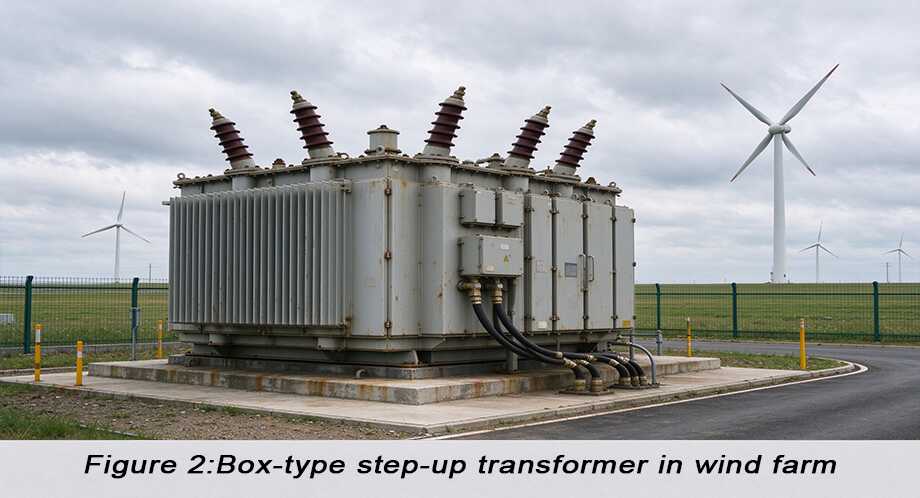
Wind turbines typically output voltages as low as 690V, while large photovoltaic (PV) stations operate at DC voltages around 1,500V. These levels are far below grid requirements. Dedicated step-up transformers installed in wind farms or near PV arrays aggregate the generated power and boost it to grid-compatible voltages (e.g., 35kV or 110kV) for efficient injection into the public grid.
3.2 Addressing Intermittency and Instability
Renewable energy generation is weather-dependent and often unstable. Modern transformers, equipped with control systems like On-Load Tap Changers (OLTC), enable rapid and automatic voltage regulation to stabilize local grid voltage and ensure “grid-friendly” integration of wind and solar power.
3.3 Key Components in DC Transmission
For offshore wind farms or ultra-long-distance power transmission, High-Voltage Direct Current (HVDC) technology offers lower losses. In these systems, converter transformers are essential—they convert AC to DC at the sending end and back to AC at the receiving end, serving as the bridge for efficient energy conversion.
| Application Scenario | Transformer Type & Role | Challenges Addressed | International Standards |
| Onshore/Offshore Wind Farms | Turbine transformers, Step-up station transformers | Boosting low turbine output to grid voltage, adapting to harsh environments | IEC 60076-16 (Transformers for Wind Turbines) |
| Large-Scale PV Power Plants | PV inverter step-up units, Packaged substations | Aggregating DC power, inverting to AC, and stepping up for grid integration | IEC 60076-11 (Dry-Type Transformers) |
| HVDC Transmission Systems | Converter transformers | Enabling efficient, high-capacity AC/DC conversion | IEC 61378 (Converter Transformers) |
| Energy Storage Systems | Bidirectional distribution transformers | Facilitating bidirectional energy flow between battery DC systems and AC grids | IEEE C57.159 |
4.Transformers as Pillars of AI and the Digital Economy
The explosive growth of artificial intelligence, cloud computing, and large-scale data centers demands unprecedented power supply characteristics: extremely high density, exceptional reliability, and efficiency. Transformers are the unsung heroes meeting these demands.
4.1 Powering High-Density Computing
AI training servers and cloud computing clusters consume enormous power, with single racks requiring tens of kilowatts. Data centers use dedicated dry-type transformers or liquid-immersed transformers to convert medium-voltage (e.g., 10kV) grid power to the low voltage (e.g., 480V/208V) required by server racks. These transformers are continuously optimized to reduce losses and lower operational costs (improving Power Usage Effectiveness or PUE).
4.2 Ensuring Uninterrupted Reliability
For AI services and cloud platforms, even millisecond-long power interruptions can lead to significant losses. Data center power architectures often employ “2N” or “N+1” redundancy designs, meaning each power path is equipped with independent transformer sets. If the primary transformer or line fails, backup transformers instantly and seamlessly take over the full load, ensuring 24/7 server operation.
| Application Scenario | Transformer Type & Role | Core Requirements & Challenges | Relevant Standards |
| Hyperscale Data Centers | Utility input transformers, UPS transformers, modular distribution transformers | Ultra-high efficiency (low PUE), extreme reliability, compatibility with 2N redundancy, low noise | ANSI/IEEE C57.12.01, C57.154 (Energy Efficiency Standards) |
| AI Computing Centers/Clusters | Dedicated distribution transformers, OLTC transformers | Handling sudden high-impact loads, providing ultra-stable voltage, high power density | IEC 60076-20 (Energy Efficiency of Distribution Transformers) |
4.3 Supporting Edge Computing Infrastructure
As AI applications extend to the network edge (e.g., autonomous driving roadside units, smart factories), compact, rugged, and maintenance-free transformers deployed at edge nodes provide stable, localized power conversion for these critical facilities.
5. Types and Selection of Transformers
Depending on insulation mediums, application scenarios, and design requirements, transformers are mainly categorized as follows:
(1)Oil-Immersed Transformers
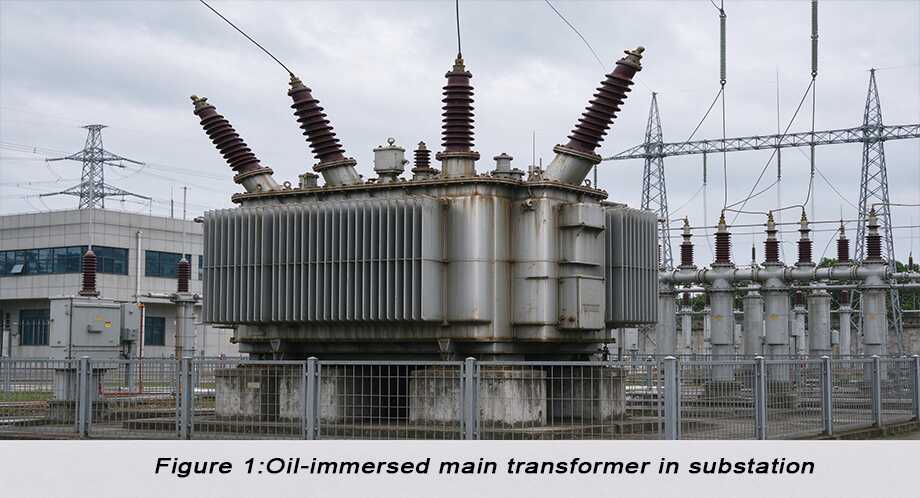
Use mineral oil or eco-friendly ester oil as insulation and cooling mediums. They offer large capacity, long lifespan, and strong overload capacity, making them the backbone of high-voltage transmission and substations. However, they require fire safety measures.
(2)Dry-Type Transformers
Use air or solid resin as insulation mediums. They excel in fire and explosion prevention, eliminating the need for oil pits and complex fire suppression systems. These are widely used in densely populated buildings like data centers, hospitals, and commercial complexes.
(3)Distribution Transformers
Typically refer to small-to-medium-sized transformers (e.g., pole-mounted transformers, packaged substations) that supply power directly to end-users by stepping down grid voltage to residential levels. They are ubiquitous in communities.
Conclusion: The Indispensable Power Hub
From safely delivering clean energy from remote locations into the grid to providing robust and stable power for AI-driven data centers, the role of transformers has evolved far beyond simple “voltage converters.” They are the intelligent adapters and safety hubs of the electrical world, silently supporting global energy transitions and digitalization.
Understanding the role of transformers is not just about knowing the function of an electrical device—it’s key to grasping how modern power systems operate efficiently, reliably, and safely. As technology advances, transformers are evolving toward greater efficiency, intelligence, and environmental sustainability, solidifying their eternal status as a cornerstone of modern infrastructure.
Contact
LuShan, est. 1975, is a Chinese professional manufacturer specializing in power transformers and reactors for 50+ years. Leading products are single-phase transformer, three-phase isolation transformers, electrical transformer, distribution transformer, step down and step up transformer, low voltage transformer, high voltage transformer, control transformer, toroidal transformer, R-core transformer; DC inductors, AC reactors, filtering reactor, line and load reactor, chokes, filtering reactor, and intermediate, high-frequency products.
Our power transformers and reactors are widely used in 10 application areas: rapid transit, construction machinery, renewable energy, intelligent manufacturing, medical equipment, coal mine explosion prevention, excitation system, vacuum sintering(furnace), central air conditioning.
Know more about power transformer and reactor: www.lstransformer.com.
If you would like to obtain customized solutions for transformers or reactors, please contact us.
WhatsApp:+86 13787095096
Email: marketing@hnlsdz.com