





Can You Use a Household Fan if a Transformer Cooling Fan Fails? —A Complete Guide to Risks & Professional Solutions
Can You Use a Household Fan if a Transformer Cooling Fan Fails?
—A Complete Guide to Risks & Professional Solutions
In the daily operation of transformers or reactors, the cooling system is critical for ensuring safe and stable performance. Maintenance personnel often face situations where a transformer’s cooling fan fails. Especially during emergencies or with limited resources, using a standard household electric fan for temporary cooling might seem like a quick fix. This article provides an in-depth exploration of this common issue, analyzing it from multiple perspectives including engineering principles, international standards, safety risks, and practical solutions, to help you make an informed, scientific decision.
Quick Answer Summary The short answer is: In a genuine emergency, a household fan might provide minimal, very short-term cooling, but this is NOT a safe or sustainable solution. Regularly using a standard fan as a replacement for the dedicated cooling fan will lead to severe performance loss, significant safety hazards, and reduced equipment lifespan. Below, we explain the reasoning and technical basis behind this.
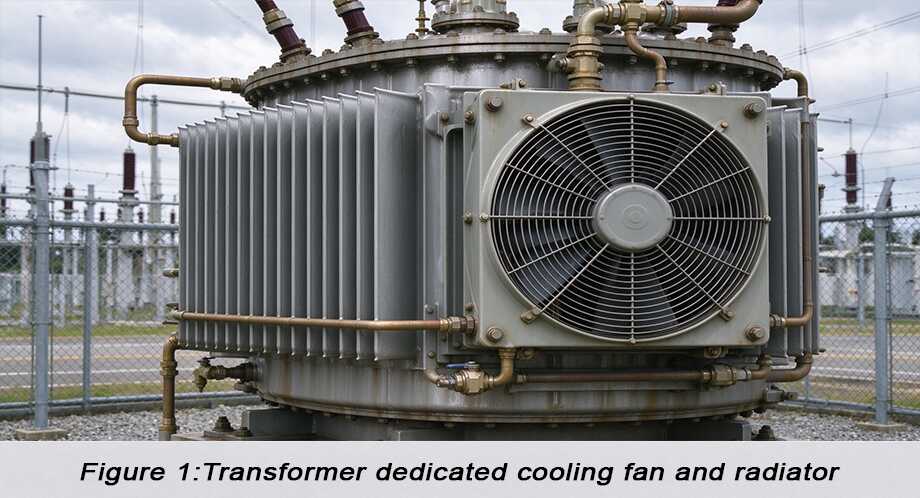
1. The Design Purpose and Critical Role of Dedicated Transformer Cooling Fans
Transformers generate substantial heat during operation due to core losses (no-load losses) and winding losses (load losses). International standards like the IEC 60076 series (International Electrotechnical Commission) and IEEE C57 series set strict limits on temperature rise for oil-immersed or dry-type transformers. Typically, the average winding temperature rise should not exceed 65K for oil-immersed types or is defined by insulation class for dry-types. The core task of the cooling system is to dissipate this heat effectively, keeping all transformer parts within their design temperature range.
1.1 Key Engineering Features of Dedicated Fans:
1.1.1 Precise Airflow & Pressure Matching:
Designed specifically for the aerodynamics of the transformer’s radiator or cooling ducts, these fans provide high static pressure, focused airflow that overcomes the significant air resistance from dense radiator fins, ensuring air penetrates the entire cooling surface.
1.1.2 Environmental Resilience:
They typically have a high Ingress Protection (IP) rating like IP54 or better, making them dust and moisture resistant for outdoor/industrial use. Their motors are Totally Enclosed Fan Cooled (TEFC) with high insulation classes (e.g., Class F), allowing continuous operation in hot environments.
1.1.3 Durability & Reliability:
They use industrial-grade bearings for long design life and continuous operation over tens of thousands of hours. Vibration and noise are minimized and controlled to meet standards.
1.1.4 Direct Consequences of Inadequate Cooling:
When cooling capacity drops, the transformer’s internal hot-spot temperature rises sharply. According to the Arrhenius equation, the aging rate of insulating paper approximately doubles for every 6°C (10.8°F) increase in temperature. Prolonged overheating leads to:
(1)Accelerated degradation of insulating materials, reducing mechanical and dielectric strength.
(2)Faster oxidation of insulating oil, generating acids and sludge, which impairs both cooling and insulation.
(3)Potential insulation breakdown, winding short circuits, and catastrophic failure.
2. Limitations of Using a Common Household Fan as a Temporary Substitute
Standard household or office fans are designed for human comfort in low-resistance environments, fundamentally differing from industrial fans in key parameters.
| Feature | Dedicated Transformer Fan (Industrial) | Standard Household/Office Fan |
| Design Goal | Overcome high air resistance for forced convective heat transfer; reliable long-term operation. | Provide broad, comfortable airflow in low-resistance environments. |
| Air Pressure (Static) | High (Typically >100 Pa), capable of penetrating dense radiators. | Very Low (Typically <20 Pa), airflow drops significantly against resistance. |
| Airflow Direction | Focused, high penetration, optimized ducting. | Diffuse, wide coverage, weak directionality. |
| Motor & Insulation | TEFC motor, Class F or H insulation, high thermal design margin. | Open or simply protected motor, lower insulation class. |
| IP Rating | IP54, IP55, or higher (dust/water resistant). | IP20 or unrated, not suitable for dust/damp. |
| Continuous Duty | Rated for 24/7 continuous operation, long design life. | For intermittent use; prolonged operation risks overheating/failure. |
| Mounting | Securely fixed to radiator/casing, minimal vibration. | No dedicated mounts; unstable placement, can tip over. |
2.1 Why Household Fans are Ineffective and Hazardous?
2.1.1 Low Pressure Drastically Reduces Heat Exchange:
Radiator fins create high air resistance. The low-static-pressure airflow from a household fan largely “bounces off” the surface or bypasses the fins, failing to carry heat away. Effective convective heat transfer requires sufficient air velocity through the fins. Ineffective airflow may provide less than 20-30% of the dedicated fan’s cooling capacity.
2.1.2 Electrical Safety Hazards:
(1) Unsuitable Environment:
Transformer areas may have oil mist, conductive dust, or high humidity. Standard fans lack appropriate protection, risking electrical shorts, fire, or becoming an ignition source if moisture/dust ingress occurs.
(2) Improper Power Supply:
Temporary extension cords may not meet industrial site standards, creating tripping or damage risks.
(3) No Integration with Temperature Controls:
Dedicated fans are typically automatically controlled by winding or oil temperature sensors (e.g., PT100) via a control cabinet. A household fan cannot integrate, requiring manual operation (easily forgotten) or continuous run (wasting energy and damaging itself), failing to provide on-demand cooling.
3. Cooling Requirements from International Standards & Industry Practices
Major international standards have clear, strict requirements for transformer cooling:
(1) IEC 60076-2:
Defines temperature rise limits and cooling designations (e.g., ONAN, ONAF, OFAF). Any modification to the certified cooling system may void the manufacturer’s warranty and potentially violate local electrical safety codes.
(2) IEEE Std C57.91:
Provides transformer loading guides with models detailing the impact of insufficient cooling on insulation life.
(3) OSHA (and similar international safety regulations):
Mandate that industrial equipment operates within its design parameters. Temporary, unsafe modifications pose compliance and liability risks.
(4) Core Principle:
The cooling system is integral to a transformer’s type tests and nameplate data. The rated capacity (e.g., 1000 kVA) on the nameplate is based on specific cooling conditions (e.g., ONAF). If cooling capacity is reduced, the safe continuous operating capacity must be derated.
4. Correct Temporary Measures & Steps During an Emergency
If a fan fails unexpectedly and power must be maintained, the following strictly temporary (not exceeding 24-48 hours) emergency protocol can be considered:
| Step | Action | Purpose & Principle | Risks & Precautions |
| 1. Assess & Reduce Load | Immediately monitor top-oil and winding temperatures (if available). If possible, reduce load to 50-70% or lower. | Reduces the heat source (copper & core losses). Based on heat balance: Q_generated = I²R + Core Loss. Lower load directly reduces I²R losses. | Load reduction may impact power supply; coordinate with users. Prioritize critical loads. |
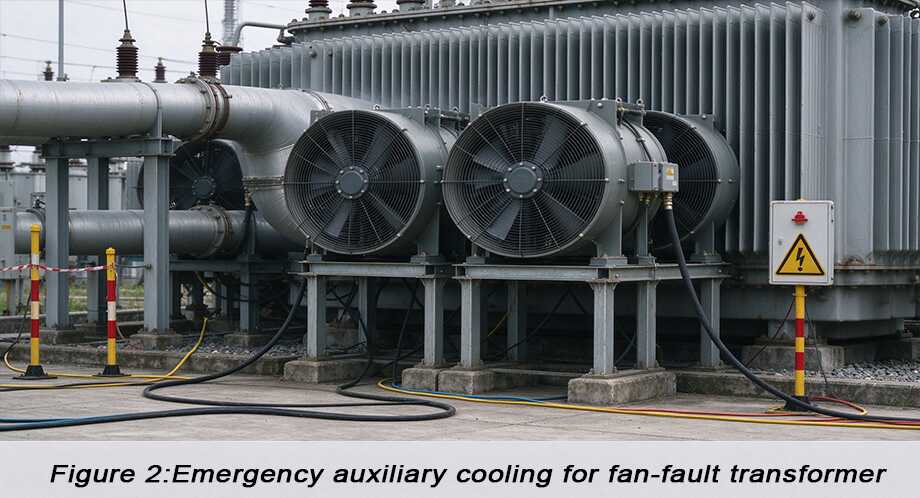
| 2. Create Auxiliary Airflow | Use multiple high-power industrial fans (not household fans) placed at a safe distance, directing air towards the transformer body and base of the radiators from different angles. | Enhances natural convection (hot air rises) by supplying cooler air at the radiator base, improving the overall chimney effect and heat circulation. | Ensure fans are properly grounded and cables are routed safely. NEVER direct fans at bushings, cable terminations, or breathers to avoid moisture/contaminant ingress or localized cooling. |
| 3. Optimize Environment | Clean all debris (dust, leaves) from between the radiator fins to ensure clear airflow paths. | This is the most effective, no-cost way to improve cooling. Dirt acts as a thermal insulator. Cleaning significantly improves efficiency even with the same airflow. | Perform cleaning only after de-energizing and verifying safety! Or use insulated tools for live-line cleaning by qualified personnel. |
| 4. Enhance Monitoring | Increase temperature monitoring frequency to hourly or more. Record data. Plan for a shutdown if oil temperature approaches/exceeds the safety limit (typically 85-95°C, refer to nameplate). | Continuous monitoring is the last defense against failure. Oil oxidation and paper aging accelerate exponentially with temperature. | Define a clear emergency shutdown procedure and temperature limit. Notify all relevant personnel. |
| 5. Contact Professional Repair | Immediately contact the equipment supplier or a professional service team to order an original or certified-compatible replacement fan. | OEM parts ensure performance match, installation compatibility, and reliability. Non-standard parts may cause vibration, noise, or even damage the radiator if improperly installed. | Provide the transformer model, nameplate data, and failed fan model/serial number to expedite the process. |
Key Formula:Temperature Rise & Heat Balance A simplified formula for steady-state temperature rise is:
ΔT ≈ (Total Losses × Thermal Resistance)
ΔT is the temperature rise above ambient (°C or K).
Total Losses include no-load loss (fixed) and load loss (proportional to the square of the load current).
Thermal Resistance is the inverse of cooling ability.
An effective cooling system (e.g., a proper fan) lowers thermal resistance, resulting in a lower ΔT for the same losses. A household fan cannot effectively lower thermal resistance, so ΔT will increase under original load conditions.
5. Long-Term Solutions & Preventive Maintenance Advice
Relying on temporary fixes is high-risk. The correct approach is a systematic maintenance strategy.
5.1 Routine Inspection & Preventive Maintenance:
(1) Monthly: Check fan operation for unusual noise or vibration.
(2) Quarterly/Biannually: Clean fan blades and radiator surfaces.
(3) Annually: Professional inspection including fan motor current measurement, insulation resistance checks, and verification of connections and capacitors (for single-phase motors).
5.2 Spare Parts Inventory:
For critical power equipment, stocking key cooling components (fan motors, impellers) is a best practice, reducing downtime from weeks to hours.
5.3 Upgrade to Smart Controls:
Consider upgrading to an intelligent, temperature/load-based fan control system. Benefits include:Staged fan operation (activating more fans as temperature rises) & Alternating fan duty to equalize wear. And Fault alarms and remote monitoring for early warning.
Conclusion
Using a common household fan when a transformer cooling fan fails is a last-resort temporary measure. It must only be considered under the strict conditions of significant load reduction, intense monitoring, and for a very limited time. From the perspectives of engineering principles, safety standards, and equipment longevity, it is a high-risk choice. The cooling system is the transformer’s “life support”; any compromise should be approached with extreme caution.
This article references international standards including IEC 60076 and IEEE C57 series. Always adhere to your local safety regulations and the equipment manufacturer’s guidelines. Before any maintenance, ensure the equipment is safely isolated using proper Lockout/Tagout (LOTO) procedures.
Contact
LuShan, est. 1975, is a Chinese professional manufacturer specializing in power transformers and reactors for 50+ years. Leading products are single-phase transformer, three-phase isolation transformers, electrical transformer, distribution transformer, step down and step up transformer, low voltage transformer, high voltage transformer, control transformer, toroidal transformer, R-core transformer; DC inductors, AC reactors, filtering reactor, line and load reactor, chokes, filtering reactor, and intermediate, high-frequency products.
Our power transformers and reactors are widely used in 10 application areas: rapid transit, construction machinery, renewable energy, intelligent manufacturing, medical equipment, coal mine explosion prevention, excitation system, vacuum sintering(furnace), central air conditioning.
Know more about power transformer and reactor: www.lstransformer.com.
If you would like to obtain customized solutions for transformers or reactors, please contact us.
WhatsApp:+86 13787095096
Email: marketing@hnlsdz.com