






Why You Should Never Test Insulation Resistance Immediately After Transformer Shutdown?
Why You Should Never Test Insulation Resistance Immediately After Transformer Shutdown?
For transformer and reactor maintenance engineers, performing regular Insulation Resistance Testing is a key part of preventive maintenance. It helps assess the health of the insulation between windings and ground, predicting potential faults. However, a common and dangerous mistake is testing immediately after shutdown.
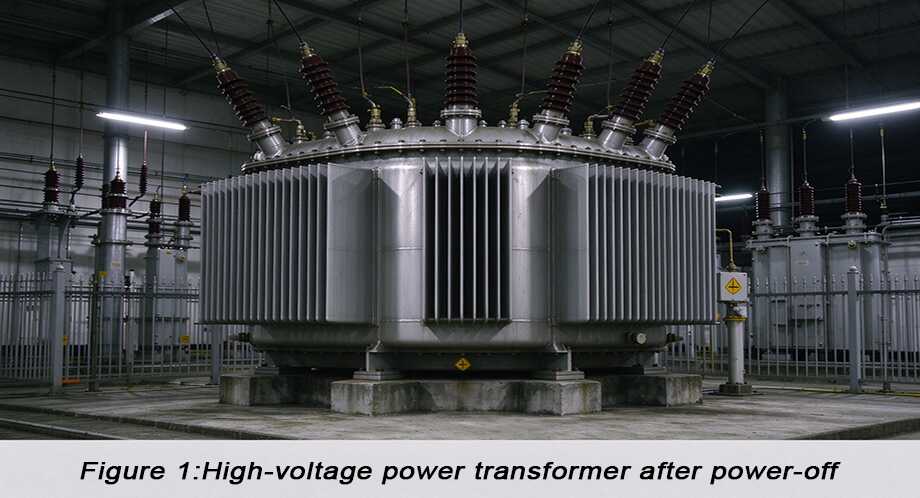
1.Why is it necessary to wait before testing?
Testing right after de-energization poses risks in two main areas: Personnel & Equipment Safety and Test Data Validity.
1.1 Primary Threat:
Residual Charge & Safety Hazards After shutdown, significant residual charge remains stored in the windings and internal capacitance, especially in large power transformers. This charge needs time to dissipate. Connecting an insulation resistance tester (Megger) immediately creates a rapid discharge path.
(1) Consequence:Extremely high instantaneous discharge current can damage the tester and cause fatal electric shock to personnel. It may also cause secondary damage to the internal insulation that hasn’t fully recovered.
(2) Reason: The tester is a DC high-voltage source (common test voltages: 500V, 1000V, 2500V, 5000V). Connecting it to an energized object forces a rapid, uncontrolled redistribution or discharge of energy. Safety standards (like IEEE and IEC) mandate a waiting period primarily to allow natural discharge to a safe voltage level.
1.2 Core Interference:
Temperature & Dielectric Absorption Even ignoring safety, data from a hot transformer does not accurately reflect true insulation condition.
(1) Temperature Effect: Operating windings can reach 80-100°C or higher. Insulation materials have a strong negative temperature coefficient—resistance drops sharply as temperature rises. This leads to falsely low readings, potentially suggesting insulation degradation.
(2) Dielectric Absorption & Polarization: Transformer insulation is a complex multi-layer system (oil, paper, pressboard). Under DC voltage, various internal polarization processes occur, requiring time to stabilize. Testing immediately after shutdown, while the dielectric is still in an unstable “excited” state, yields rapidly changing, unrealistic readings.
2.How long should you wait before testing?
There’s no fixed time. It depends on voltage rating, capacity, and operating temperature. Standards like IEEE Std 43-2013 provide guidance. A general rule is to wait at least 4 to 8 times the thermal time constant, or until the equipment temperature is close to ambient temperature. For large transformers, this often means several hours or more.
| Equipment Type / Voltage Level | Suggested Minimum Wait Time | Key Considerations |
| Low Voltage Distribution Transformer (≤1000V) | 30 minutes – 2 hours | Residual charge dissipation, initial cooling. |
| Medium Voltage Transformer (1kV – 35kV) | 2 hours – 8 hours | Higher capacitive energy storage, requires more thorough discharge and cooling. |
| High/Extra-High Voltage Power Transformer (≥66kV) | 8+ hours, often 24 hours recommended | Large capacitance, complex insulation, significant dielectric absorption, needs cooling to ambient temperature. |
Important: This table is a general guide. Always follow the manufacturer’s specific manual and your site’s Lockout/Tagout (LOTO) procedures. Before contacting any terminals, always verify the equipment is de-energized using a calibrated high-voltage detector.
3. How to obtain and interpret valid insulation resistance data?
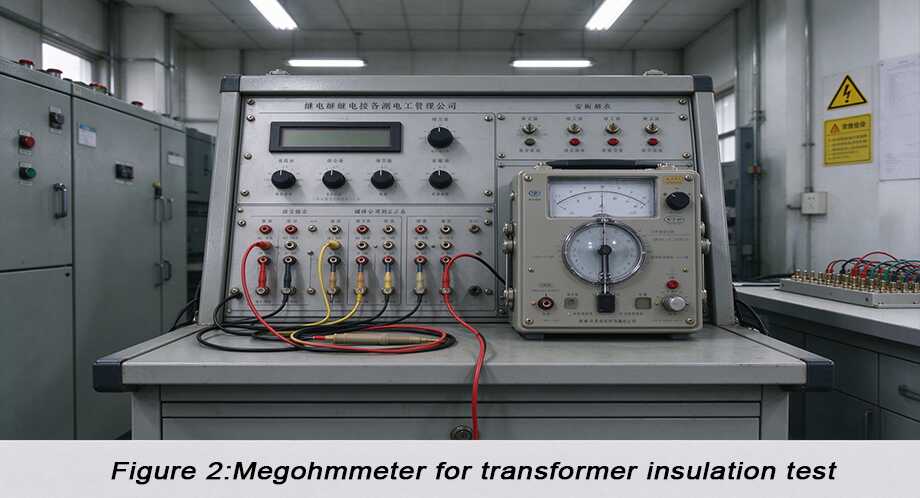
After sufficient cooling and discharge, proceed with testing. Correct interpretation is crucial, utilizing two key diagnostic parameters: Dielectric Absorption Ratio (DAR) and Polarization Index (PI).
3.1 Dielectric Absorption Ratio (DAR):
(1) Ratio of the 60-second insulation resistance value to the 15-second value. (DAR = R₆₀s / R₁₅s)
(2) Polarization Index (PI): Ratio of the 10-minute insulation resistance value to the 1-minute value. (PI = R₁₀min / R₁min)
3.2Why are they effective?
Good, dry, clean insulation shows a significant increase in resistance over time under DC voltage as the absorption current decays slowly. For wet or contaminated insulation, the steady leakage current dominates, so resistance doesn’t rise much.
PI and DAR essentially compare the slow polarization (absorption) current to the steady leakage current. A high ratio indicates good insulation; a ratio near 1 indicates moisture or contamination.
Conclusion
Safety First, Wait Patiently: Follow proper isolation, discharge, and verification procedures. Allow adequate cooling and natural discharge time. By following this process, you ensure safety and transform a simple check into a powerful diagnostic tool for predicting transformer health. High-quality maintenance data is the foundation for optimal operational decisions.
Disclaimer: This information is based on general international standards and practices. Always prioritize the manufacturer’s instructions, local/national safety codes, and have work performed by qualified personnel.
Contact
LuShan, est. 1975, is a Chinese professional manufacturer specializing in power transformers and reactors for 50+ years. Leading products are single-phase transformer, three-phase isolation transformers, electrical transformer, distribution transformer, step down and step up transformer, low voltage transformer, high voltage transformer, control transformer, toroidal transformer, R-core transformer; DC inductors, AC reactors, filtering reactor, line and load reactor, chokes, filtering reactor, and intermediate, high-frequency products.
Our power transformers and reactors are widely used in 10 application areas: rapid transit, construction machinery, renewable energy, intelligent manufacturing, medical equipment, coal mine explosion prevention, excitation system, vacuum sintering(furnace), central air conditioning.
Know more about power transformer and reactor: www.lstransformer.com.
If you would like to obtain customized solutions for transformers or reactors, please contact us.
WhatsApp:+86 13787095096
Email: marketing@hnlsdz.com