






Can a Transformer with “Bulging Coils” Continue to Operate? — Causes, Risk Assessment, and Professional Solutions
Can a Transformer with “Bulging Coils” Continue to Operate?
— Causes, Risk Assessment, and Professional Solutions
Transformers and reactors are critical components in global power systems and industrial equipment. Their stable operation is directly tied to grid safety and production efficiency. In recent years, popular search terms such as “transformer failure,” “transformer coil bulging causes,” and “transformer repair solutions” reflect widespread user concern regarding transformer safety. This article provides a detailed exploration of the causes, risks, and countermeasures for transformer coil bulging, helping you make informed decisions.
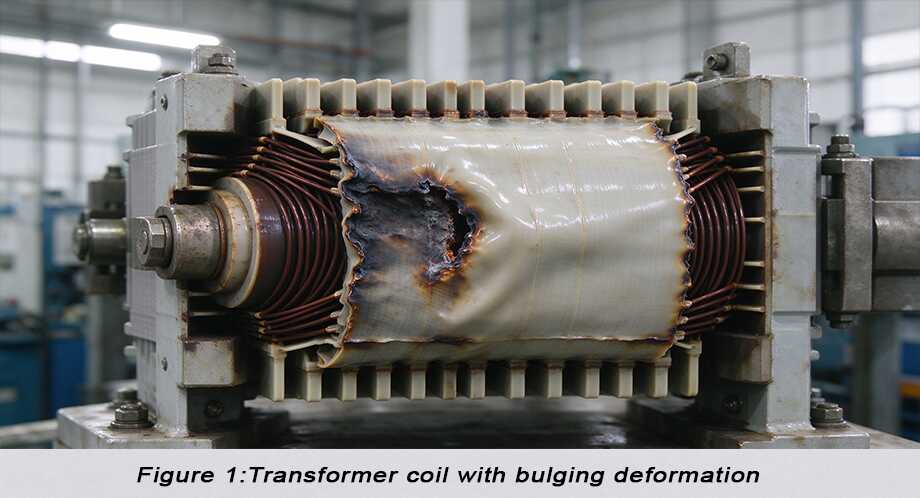
1. Analysis of the Causes of Transformer Coil Bulging
Transformer coil bulging refers to the local expansion or deformation of the coil under the influence of electromagnetic force, thermal stress, or mechanical force. The primary causes can be categorized into electromagnetic forces, thermal effects, and mechanical/structural issues.
1.1 Coil Deformation Caused by Electromagnetic Forces
During transformer operation, the windings carrying current generate electromagnetic forces. These forces increase dramatically under short-circuit or overload conditions. According to the International Electrotechnical Commission standard IEC 60076, the electromagnetic force can be calculated using the following formula:
F = B * I * L
Where:
F is the electromagnetic force (in Newtons).
B is the magnetic flux density (in Tesla).
I is the current flowing through the coil (in Amperes).
L is the length of the coil (in meters).
When the electromagnetic force exceeds the yield strength of the coil material, the coil undergoes plastic deformation, gradually forming a bulge. This situation is common in transformers with design flaws or those subjected to long-term overload operation.
1.2 Material Expansion Due to Thermal Effects
Increased operating temperatures cause the coil material (such as copper or aluminum) to expand thermally. According to the thermal expansion formula:
ΔL = α * L₀* ΔT
Where:
ΔL is the change in length.
α is the coefficient of linear expansion (approximately 1.7×10⁻⁵/°C for copper).
L₀ is the original length.
ΔT is the change in temperature.
Long-term overload or cooling system failure can cause the coil temperature to remain consistently above the design value (typically 65-80°C), leading to insulation aging and coil expansion/deformation. The thermal aging of insulation materials follows the Arrhenius law, where life expectancy is halved for every 8-10°C increase in temperature.
1.3 Mechanical/Structural Defects and External Stress
Poor manufacturing processes (e.g., uneven coil winding) or external mechanical impacts (e.g., transportation collisions) can lead to localized stress concentration. For example, loose coil support structures can cause uneven distribution of electromagnetic forces, accelerating bulge formation. Additionally, shrinkage of insulation materials (e.g., from improper drying) can also increase the risk of deformation.
| Cause Category | Specific Factors | Typical Characteristics | Common Scenarios |
| Electromagnetic Force | Short-circuit current, Design flaws | Localized symmetrical bulge, accompanied by noise | Grid short-circuit, Overload operation |
| Thermal Effects | Cooling failure, Overload operation | Overall expansion, Insulation discoloration | High-temperature environment, Poor heat dissipation |
| Mechanical Structure | Process defects, External impact | Asymmetric deformation, Loose structure | Aging equipment, Post-transport startup |
2. Can a Bulging Coil Continue to Be Used? A Risk Assessment Guide
Coil bulging not only affects transformer performance but may also lead to serious accidents. The decision to continue use must be based on the following risk assessment:
2.1 Safety Risk Analysis
Bulging alters the electrical clearances within the coil, leading to increased partial discharge and accelerated insulation aging. In severe cases, it may cause inter-turn short circuits or ground faults, resulting in power outages or even fires. According to the IEEE standard C57.152, a partial discharge level exceeding 5 pC warrants an alert.
2.2 Performance Impact Assessment
Bulging causes changes in the coil’s inductance parameters, affecting voltage regulation accuracy and efficiency. For instance, a 10% coil deformation may increase no-load loss by 3-5% and raise the temperature rise by 8-10°C, failing to comply with the IEC 60076 energy efficiency standard.
2.3 Lifespan and Economic Trade-offs
Continued use of a bulging coil may shorten the transformer’s lifespan by 30-50%. In contrast, replacing the coil or performing comprehensive repairs typically costs 20-40% of the equipment’s value but can extend its life by over 15 years. The decision must comprehensively consider downtime losses, repair costs, and safety regulations (such as EU CE marking requirements).
3. Professional Solutions and Preventive Measures
If the bulging is minor and the assessed risk is controllable, repair measures can be taken; otherwise, coil replacement is recommended. Below are tiered solutions:
3.1 On-site Inspection and Assessment Process
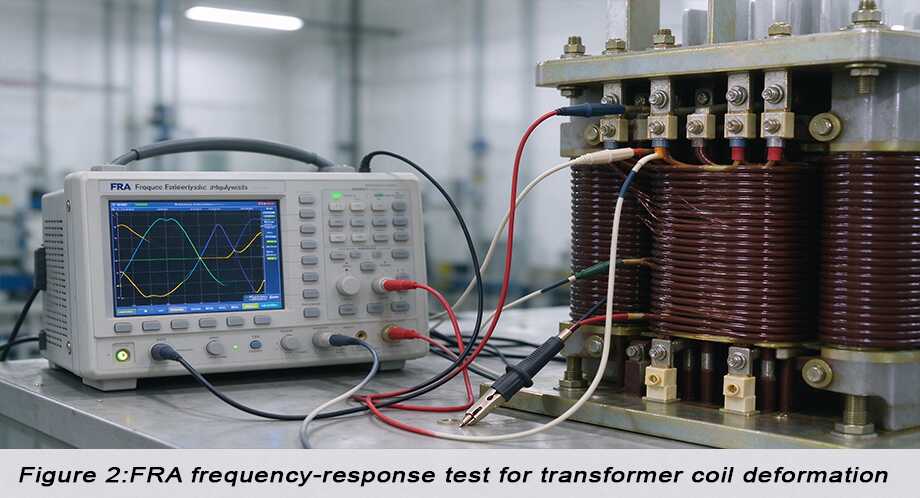
Begin with electrical tests (e.g., winding resistance test, turns ratio test) and physical inspections (e.g., Frequency Response Analysis – FRA). FRA can determine the degree of deformation by comparing spectrum curve differences; an difference greater than 2% indicates a need for intervention.
3.2 Detailed Repair Techniques
For local bulging, epoxy resin infusion curing technology can be employed. This technique involves injecting resin into the gaps between coil layers under vacuum pressure. Once cured, it forms a uniform support layer, restoring mechanical strength. The principle relies on the resin’s curing shrinkage rate being less than 0.5%, effectively compensating for deformation gaps.
| Solution | Applicable Severity | Key Technology | Expected Outcome | Cost & Timeframe |
| Resin Curing | Bulging < 5% | Vacuum Infusion | Restores ~80% strength | Medium / 3-5 days |
| Coil Rewinding | Bulging > 5% | CNC Winding | Complete restoration | High / 2-4 weeks |
| Full Replacement | Severe deformation | Custom Manufacturing | New equipment standards | Very High / 1-2 months |
Conclusion
Transformer coil bulging results from the combined effects of electromagnetic forces, thermal effects, and mechanical factors. Minor bulging may allow for limited continued use after professional repair, but severe deformation requires immediate replacement. It is recommended to establish a full-lifecycle management approach—”Inspection-Assessment-Repair-Prevention”—in accordance with IEEE/IEC standards to ensure the safe and efficient operation of transformers. Implementing the solutions outlined in this article can enhance equipment lifespan by over 30%, meeting the safety and energy efficiency requirements of the global market.
Contact
LuShan, est. 1975, is a Chinese professional manufacturer specializing in power transformers and reactors for 50+ years. Leading products are single-phase transformer, three-phase isolation transformers, electrical transformer, distribution transformer, step down and step up transformer, low voltage transformer, high voltage transformer, control transformer, toroidal transformer, R-core transformer; DC inductors, AC reactors, filtering reactor, line and load reactor, chokes, filtering reactor, and intermediate, high-frequency products.
Our power transformers and reactors are widely used in 10 application areas: rapid transit, construction machinery, renewable energy, intelligent manufacturing, medical equipment, coal mine explosion prevention, excitation system, vacuum sintering(furnace), central air conditioning.
Know more about power transformer and reactor: www.lstransformer.com.
If you would like to obtain customized solutions for transformers or reactors, please contact us.
WhatsApp:+86 13787095096
Email: marketing@hnlsdz.com