
 EN
EN
 FR
FR DE
DE ES
ES
Key Points of Explosion-Proof Design for Oil-Immersed Transformers: How Do Pressure Relief Devices and Gas Relays Work Together?
Key Points of Explosion-Proof Design for Oil-Immersed Transformers: How Do Pressure Relief Devices and Gas Relays Work Together?
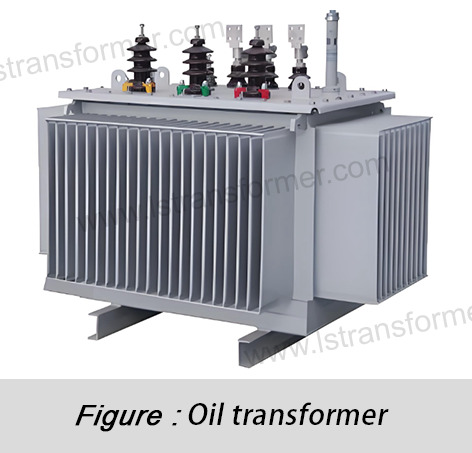
Oil-immersed transformers are widely used in global power infrastructure due to their excellent insulation and heat dissipation capabilities. However, internal faults can lead to a rapid increase in pressure and decomposition of insulating oil, posing a serious risk of explosion. The International Electrotechnical Commission (IEC) and IEEE standards emphasize the importance of explosion-proof systems for transformer safety. This article delves into the working principles, collaborative mechanisms, and design considerations of two core explosion-proof components—the pressure relief device (PRD) and the gas relay (Buchholz relay)—to help power engineers and maintenance personnel fully understand this critical safety system.
1. Internal Faults in Oil-Immersed Transformers and Explosion-Proof Requirements
● Types and Consequences of Internal Faults
Internal faults in oil-immersed transformers fall into two categories: electrical faults and thermal faults. Electrical faults include inter-turn short circuits, layer short circuits, and ground faults, while thermal faults involve localized core overheating and poor heat dissipation due to oil flow blockage. According to IEEE C57.12.00 standards, these faults trigger the following chain reactions:
Fault Type | Physical Effects | Potential Consequences |
Partial discharge | Bubble formation, initial oil decomposition | Gradual insulation degradation |
Arc fault | Instantaneous high temperature (>3000°C), pressure surge | Tank deformation/rupture risk |
Continuous overheating | Oil pyrolysis (70% H₂ + 20% hydrocarbons) | Accumulation of flammable gas mixtures |
Table 1: Types of transformer internal faults and their physical effects
● Gas Generation Dynamics
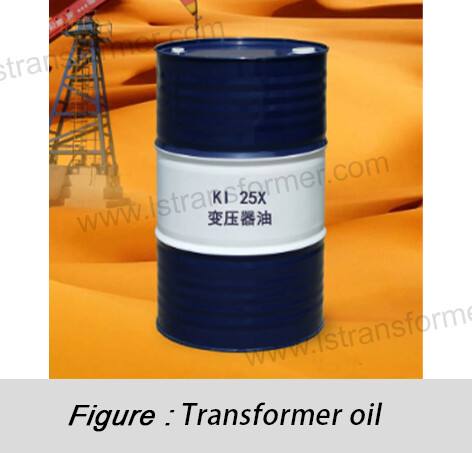
The decomposition of insulating oil (typically mineral oil) under fault conditions follows the Arrhenius equation:
k = A·e^(-Ea/RT)
Where:
k: Reaction rate constant
A: Frequency factor (oil-dependent, typically 10^12~10^14 s^-1)
Ea: Activation energy (~210 kJ/mol for mineral oil)
R: Ideal gas constant (8.314 J/mol·K)
T: Absolute temperature (K)
This equation shows that the reaction rate doubles for every 10°C increase in temperature. When the fault point exceeds 500°C, several cubic meters of gas can be generated within minutes.
2. Pressure Relief Device (PRD): The First Line of Defense Against Transient Overpressure
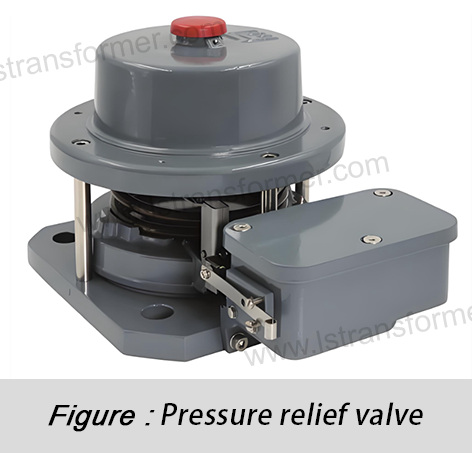
● Working Principle and Mechanical Design
The PRD uses a spring-diaphragm mechanism. Its opening pressure (P_open) is determined by:
P_open = (F_spring - F_preload)/A_seal
Where:
F_spring: Spring force (N)
F_preload: Installation preload force (N)
A_seal: Sealing area (m²)
The typical setting is 70±5 kPa (per IEC 60076), below the tank’s withstand limit (usually 140 kPa) but above normal operating pressure (<35 kPa).
● Key Performance Parameters and Selection
Parameter | Standard Type | High-Performance Type | Rupture Disc Type |
Response time | <10 ms | <5 ms | Instantaneous |
Reset pressure difference | 15-20% | 8-12% | Non-resettable |
Flow coefficient (Cv) | 5-10 | 10-15 | 20+ |
Applicable faults | Slow-developing | Fast arc faults | Extreme scenarios |
Table 2: PRD performance comparison (based on IEEE Std C57.12.10)
Note:Cv is defined as the flow rate (in gallons per minute) of water at 60°F with a 1 psi pressure drop, reflecting venting capacity.
3. Gas Relay: The Precision Guardian for Gas Monitoring
● Dual-Float Mechanism
Modern gas relays use magnetically coupled floats:
(1)Upper float:Responds to oil flow velocity (alarm trigger, typically 0.6-1.2 m/s)
(2)Lower float:Responds to gas accumulation (trip trigger, usually 250±50 mL)
The gas accumulation rate (dv/dt) correlates with fault severity. A rate >12%/h requires immediate shutdown (per IEC 60599).
● Gas Chromatography and Fault Diagnosis
Collected gases are analyzed using the Duval Triangle method:
%CH4 = [CH4]/([H2]+[CH4]+[C2H4]) × 100%
%C2H4 = [C2H4]/([H2]+[CH4]+[C2H4]) × 100%
Typical fault zones:
(1) PD (partial discharge): CH4 >70%
(2) T1 (low-temperature overheating): CH4 30-70%, C2H4 <15%
(3)T2 (medium-temperature overheating): C2H4 15-50%
(4)T3 (high-temperature overheating): C2H4 >50%
4. Collaborative Mechanism and System Integration
The explosion-proof safety of oil-immersed transformers relies on the time-synchronized and spatially complementary actions of the PRD and gas relay. Together, they form a complete protection chain from early warning to emergency pressure relief. Below is their collaborative workflow:
● Fault Response Timeline
Time Scale | Fault Stage | PRD Action | Gas Relay Action | Collaborative Principle |
0-100 ms | Sudden arc fault | Rapid venting (5-10 ms response) | Inactive (low oil flow) | PRD prevents tank rupture from pressure shock |
1 min-1 h | Slow overheating/PD | Closed (pressure below threshold) | Alarm (upper float) or trip (lower float) | Relay detects gas accumulation for early intervention |
>1 h | Post-fault | Resets (pressure drops to 70%) | Maintains trip signal | Prevents restart before fault resolution |
Key logic: PRD handles pressure spikes (physical), while the relay monitors gas (chemical).
● Spatial Layout (Per IEC 60296 and IEEE C57.12.00)
(1)Elevation:Gas relay must be installed on the pipe between the conservator and tank, with a ≥5° tilt (≥7° in Europe) to ensure gas flows to the relay.
(2)Pressure isolation:PRD vent must be ≥1.8 m from the relay, angled ≥45° to avoid interference.
(3)Oil flow dynamics:Minimum flow Qmin=0.26×D^2.5 (L/min) (D = pipe diameter in cm) ensures reliable float movement.
● Case Simulation (Turn-to-Turn Short Circuit)
(1)t=0s: Short-circuit heats oil to >1000°C, generating H₂ and C₂H₂.
(2)t=15s: Gas accumulation rate hits 50 mL/s → relay trips.
(3)t=18s: If breaker fails, pressure surges to 70 kPa → PRD vents.
(4)t=30s: PRD releases hot oil-gas mix, averting explosion.
(5)t=5min: Gas analysis confirms fault type.
In Summary
Modern explosion-proof systems for oil-immersed transformers integrate multi-parameter monitoring and layered protection. To enhance safety and reliability, operators should:
(1)Test PRDs annually (including seal checks).
(2)Verify gas relay function every 6 months.
(3)Simulate full system responses biennially.
These measures comply with IEC 60599 and IEEE C57.104 standards, extending transformer lifespan and operational safety.
Contact Us
LuShan, est.1975, is a Chinese professional manufacturer specializing in power transformers and reactors for 50+ years. Leading products aresingle-phase transformer, three-phase isolation transformers,electrical transformer,distribution transformer, step down and step up transformer, low voltage transformer, high voltage transformer, control transformer, toroidal transformer, R-core transformer;DC inductors, AC reactors, filtering reactor, line and load reactor, chokes, filtering reactor, and intermediate,high-frequency products.
Our power transformers and reactors are widely used in 10 application areas: rapid transit, construction machinery, renewable energy, intelligent manufacturing, medical equipment, coal mine explosion prevention , excitation system, vacuum sintering(furnace), central air conditioning.
Know more about power transformer and reactor :www.lstransformer.com.
If you would like to obtain customized solutions for transformers or reactors, please contact us.
WhatsApp:+86 17267488565
Email:[email protected]