
 EN
EN
 FR
FR DE
DE ES
ES
Can Power Be Restored Immediately After a Heavy Gas Trip? —Detailed Process of Fault Gas Chromatography Analysis
Can Power Be Restored Immediately After a Heavy Gas Trip?
—Detailed Process of Fault Gas Chromatography Analysis
When a transformer's heavy gas element (Buchholz Relay Heavy Gas Element) trips, operators face a critical question: Can power be restored immediately? This decision directly impacts equipment safety and grid stability. Incorrect judgments may worsen the fault, potentially leading to fires or explosions. Global power industry data shows that blindly restoring power after a heavy gas trip is a leading cause of severe transformer failures. Therefore, before taking any action, a scientific fault gas chromatography analysis (DGA) must be conducted to determine the fault type, following international standards (e.g., IEC 60599, IEEE C57.104).
Content
1. Heavy Gas Trip: A Critical Alarm for Severe Faults
The heavy gas element is a core non-electrical protection device in oil-immersed transformers. Its operation is based on gas production rate and flow velocity:
(1)Mechanism:When severe gas-producing faults (e.g., arcing, extreme overheating) occur inside the transformer, large volumes of gas rapidly enter the Buchholz relay, triggering the heavy gas contact.
(2)Trigger Condition:Gas production rate is extremely high (typically > 100 mL/s), and the accumulated gas volume overcomes mechanical resistance.
(3)Indicated Faults:
-High-energy discharge:Interturn/short-circuit winding, broken leads causing arcing.
-Severe overheating:Core multipoint grounding, large-area poor contact.
-Intense oil decomposition:Accompanied by high temperatures or discharge.
Key Conclusion:A heavy gas trip = a rapidly developing, high-energy latent fault inside the transformer. It is not random or a false operation.
2. Why Must Fault Gas Chromatography Analysis (DGA) Be Relied On?
After a heavy gas trip, relying solely on visual inspections or basic electrical tests is dangerous and insufficient. Reasons:
(1)Hidden Fault Locations:Fault points are often deep within windings, cores, or insulation, making direct observation impossible.
(2)Critical Gas Composition:Different faults (discharge, overheating) decompose transformer oil hydrocarbons into specific gas combinations.
(3)Quantifying Fault Severity:Gas concentration and production rates reflect fault energy levels and progression stages.
Core Advantage of DGA: By precisely separating and detecting trace gases (ppm-level) dissolved in oil, it "decodes" fault type, location, and severity.
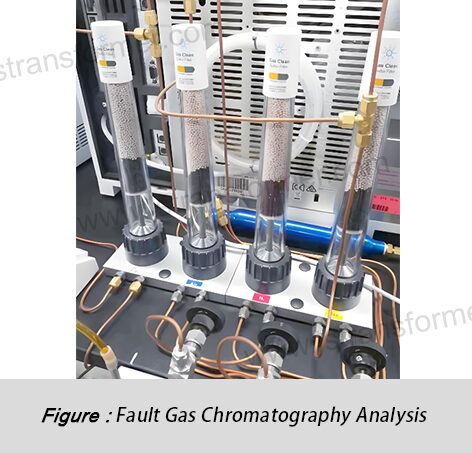
3. Fault Gas Chromatography Analysis (DGA) Process (Step-by-Step)
Following IEEE C57.104 and IEC 60599, the DGA process after a heavy gas trip must be rigorous:
Key Step | Operation & Purpose | International Standard | Reason & Necessity |
1. Safety Isolation & Sampling | Disconnect breakers, ground the transformer. Use aspecialized syringe/vacuum bottleto collect oil samples, avoiding bubbles. | IEEE C57.104 (Clause 6) | Prevents fault escalation; ensuresgas integrity. |
2. Lab Gas Chromatography | UseTCD/FID-equipped chromatographsto measureH₂, CH₄, C₂H₆, C₂H₄, C₂H₂, CO, CO₂(ppm-level). | IEC 60599 (Annex A) | Identifieskey fault gaseswith high precision. |
3. Diagnosis & Fault Typing | ApplyRogers Ratio, Doernenburg Ratio, Duval Triangle, or IEC 60599 methods. | IEC 60599 (Clause 7) | Eliminates load effects;pinpoints fault type. |
Diagnostic Method Example (Rogers Ratio):
(1)Principle:Calculate 5 gas ratios (e.g., CH₄/H₂, C₂H₂/C₂H₄), convert to 3-digit codes, and match with standard tables.
(2)Result:Determines fault type (e.g., "low-temperature overheating," "high-energy discharge").
(3)Advantage:Highly resistant to interference.
Fault Type | Primary Gases | Secondary Gases | Gas Production Mechanism |
Partial Discharge (PD) | H₂, CH₄ | Trace C₂H₂ | Electron collisions break oil molecules (low temp). |
Low-Temp Overheating (<300°C) | CH₄, C₂H₄ | C₂H₆ | Oil pyrolysis (hydrocarbon dehydrogenation). |
Medium/High-Temp Overheating (300–700°C) | C₂H₄, CH₄ | H₂, C₂H₆ | Severe oil/paper decomposition. |
High-Energy Discharge (Arcing) | C₂H₂, H₂ | C₂H₄, CH₄ | Arc temperatures >3000°C fully crack oil molecules. |
Low-Energy Discharge (Spark) | H₂, C₂H₂ (low) | CH₄, C₂H₄ | Intermittent energy release. |
Solid Insulation Overheating | CO, CO₂ | CH₄, C₂H₄ | Cellulose decomposition (furan compounds). |
Table: Fault types vs. gas signatures (perIEC 60599).
4. Decision Tree for Power Restoration (Based on DGA Results)
● Absolutely Forbid Restoration (Immediate Internal Inspection Required):
(1)High-energy discharge (arcing):Rogers code "102" or "112," or Duval Triangle in Zone 1. Risk: Metal short circuits may cause explosions.
(2)C₂H₂ (Acetylene) > 50 ppm (new transformers) or rising >10 ppm/day. Reason:Indicates insulation destruction.
(3)Total hydrocarbons > 1000 ppm or rising >100 ppm/day. Reason:Fault is actively worsening.
● Restore Only After Full Inspection & DGA Monitoring:
(1)Medium/high-temperature overheating:Rogers code "022" (core/clamp overheating). Action: Fix grounding/loose parts, retest DGA before restoring.
(2)CO/CO₂ rise (non-temperature cause):Indicates solid insulation aging. Action: Check DP value; if DP > 500 and root cause fixed, restore with monitoring.
● Cautious Restoration (Rare Cases):
(1)Confirmed external cause (e.g., relay misoperation due to vibration) + normal DGA history.
(2)Low-energy discharge:If gas levels are low and stable, and ultrasonic tests confirm no risk. Action: Fix loose parts before restoring.
5. Beyond Diagnosis: DGA’s Role in Post-Restoration Safety
Restoration is not the end—ongoing DGA monitoring is critical:
(1)Trend tracking:Weekly oil tests, plot gas concentration vs. time, calculate production rates (ppm/day).
(2)Early warning:If C₂H₂ or H₂ rise again, shut down immediately.
(3)Verify repairs:Post-maintenance DGA should show stable/declining gas levels.
Formula (IEC 60599 Absolute Gas Production Rate):
γa = (Ct2 - Ct1) / Δt × (m / ρ)
γa: Gas production rate (mL/day)
Ct2, Ct1: Gas concentrations at times t2, t1 (ppm)
Δt: Days between tests
m: Total oil mass (kg)
ρ: Oil density (kg/m³)
In Summary
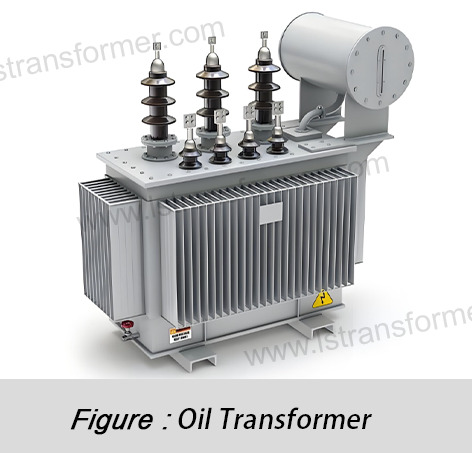
Transformers are critical grid assets, and post-trip procedures determine their future reliability. DGA analysis, strict adherence to IEC/IEEE standards, and continuous monitoring are essential for safety. In today’s smart grid era, data-driven decisions outperform experience. Only by following scientific protocols can risks be minimized, ensuring every "close command" is safe and justified.
Contact Us
LuShan, est.1975, is a Chinese professional manufacturer specializing in power transformers and reactors for 50+ years. Leading products aresingle-phase transformer, three-phase isolation transformers,electrical transformer,distribution transformer, step down and step up transformer, low voltage transformer, high voltage transformer, control transformer, toroidal transformer, R-core transformer;DC inductors, AC reactors, filtering reactor, line and load reactor, chokes, filtering reactor, and intermediate,high-frequency products.
Our power transformers and reactors are widely used in 10 application areas: rapid transit, construction machinery, renewable energy, intelligent manufacturing, medical equipment, coal mine explosion prevention , excitation system, vacuum sintering(furnace), central air conditioning.
Know more about power transformer and reactor :www.lstransformer.com.
If you would like to obtain customized solutions for transformers or reactors, please contact us.
WhatsApp:+86 17267488565
Email:[email protected]