
 EN
EN
 FR
FR DE
DE ES
ES
How to Choose Terminal Configurations for Transformers and Reactors Based on Current Rating?
How to Choose Terminal Configurations for Transformers and Reactors Based on Current Rating?
In the design and application of transformers and reactors, the choice of terminal configuration directly impacts equipment performance, safety, and service life. For different current ratings, engineers must consider factors such as conductor ampacity, thermal effects, and electromagnetic compatibility. This article systematically analyzes how current rating influences terminal configuration selection, covering scenarios from low-voltage/low-current to high-voltage/high-current applications. Referencing international standards like IEC 60076 and IEEE C57, it provides actionable insights to help you make globally compliant technical decisions.
Content
1. Fundamental Relationship Between Current Rating and Terminal Configurations
● Thermal Effects and Conductor Cross-Section
When current flows through a conductor, Joule heating occurs due to electrical resistance. The heat generated (Q) is expressed as:
Q = I²Rt
Where:
Q: Heat generated (Joules)
I: Current (Amperes)
R: Conductor resistance (Ohms)
t: Time (seconds)
This formula shows that heat generation is proportional to the square of the current. For high-current applications, conductors with sufficient cross-sectional area are essential to prevent overheating. Per IEC 60287, the ampacity of copper conductors in free air (30°C ambient) is:
Cross-Section (mm²) | Continuous Current Rating (A) |
10 | 70 |
25 | 110 |
50 | 160 |
100 | 250 |
Table 1: Current-carrying capacity of copper conductors at varying cross-sections.
● Skin Effect and Terminal Design
At higher frequencies or currents, the Skin Effect causes AC current to concentrate near the conductor surface. Skin depth (δ) is calculated as:
δ = √(ρ/πfμ)
Where:
ρ: Resistivity (Ω·m)
f: Frequency (Hz)
μ: Permeability (H/m)
For 50Hz power frequency, copper’s skin depth is ~9.3mm. Thus, solid conductors become inefficient for high currents. Instead, stranded wires or hollow tubular designs are preferred. For example, currents exceeding 2000A often use parallel copper bars or hollow conductors to optimize current distribution.
2. Terminal Configuration Selection by Current Range
● Low Current (<100A) Solutions
For low-current applications, reliability and cost-efficiency are key:
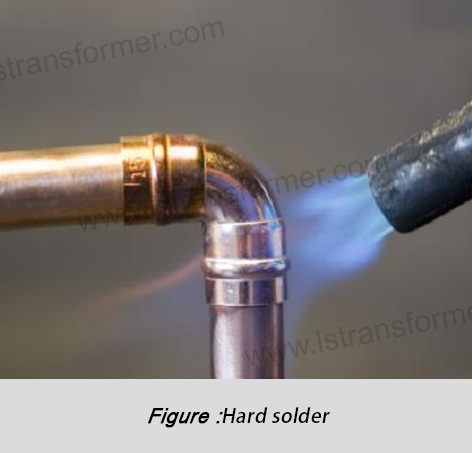
(1)Soldered Terminals: Permanent connections (e.g., copper/silver solder) offer ultra-low contact resistance (<10μΩ) but are non-detachable.
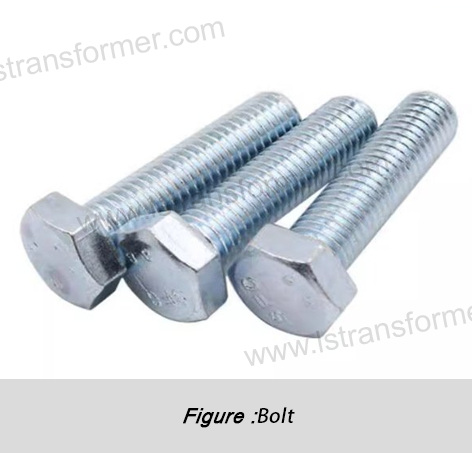
(2)Bolted Terminals: M6-M10 bolts secure terminals to windings. Surface roughness (<3.2μm Ra) and anti-oxidant grease (e.g., Dow Corning® DC-4) reduce contact resistance by 40%.
(3)Crimped Terminals: Hydraulic crimping avoids heat-affected zones, ideal for aluminum. Per IEC 61238, crimps must withstand 100+ thermal cycles (-40°C to +120°C) without resistance degradation.
● Medium Current (100–1000A) Solutions
Thermal and electromagnetic management becomes critical:
(1)Multi-Terminal Parallel Design: Splitting current across 4+ terminals (e.g., M12 bolts) reduces per-point heating by 1/16. Tests show 25K lower temperature rise in 500A applications.
(2)Water-Cooled Terminals: Integrated coolant channels (deionized water, conductivity <5μS/cm) boost ampacity by 30–50%. Real-world data shows 40°C lower temperatures at 800A vs. air-cooled designs.
(3)Phase-Change Materials (PCMs): Paraffin-based PCMs absorb overload heat (200–300kJ/kg). During 200% overloads, PCMs limit temperature rise to 50% of conventional designs.
● High Current (>1000A) Solutions
Addressing electromagnetic forces and thermal expansion:
(1)Coaxial Tubular Conductors:Hollow tubes with counter-flowing currents cancel 70–80% of Lorentz forces (F=BIl). Vibration tests show 60% lower amplitude vs. flat busbars.
(2)Segmented Insulation Barriers:Epoxy-glass barriers between phases increase partial discharge inception voltage by 30–40% (per Paschen’s Law).
(3)Active Magnetic Compensation: Sensor-controlled windings balance fields (±1% uniformity), cutting eddy losses by 80%. Real-world HVDC transformers save ~12,000kWh/year.
3. Special Application Considerations
● High-Frequency High-Current (e.g., SMPS, Induction Furnaces)
(1)Litz Wire Terminals:Hundreds of insulated strands (each <2× skin depth) reduce AC resistance by 3–5x. Example: At 100kHz, 5mm² Litz wire has 0.5mΩ/m vs. 1.8mΩ/m for solid wire.
(2)Layered Terminals: Stacked 0.1mm copper foils with polyimide insulation cut losses by 15–25% at 20–100kHz.
● DC+AC Mixed Current (e.g., VFDs, HVDC Valves)
(1)Nickel-Plated Contacts: ≥50μm nickel coatings suppress electrolytic corrosion (<1μm/year vs. 10–15μm for bare copper).
(2)Hybrid Insulation: Silicone rubber (AC performance) + epoxy (DC strength) reduces partial discharge by 50% in offshore wind converters.
In Summary
Transformer and reactor terminal configurations must align with current rating, frequency, cooling needs, and mechanical stress. Low currents (<100A) suit soldered/bolted terminals, medium currents (100–1000A) demand multi-terminal or cooled designs, while high currents (>1000A) require coaxial conductors or active compensation. High-frequency applications benefit from Litz wires, and DC+AC mixes need corrosion-resistant coatings. Always comply with IEC/IEEE standards and validate designs via simulation/testing.
Contact Us
LuShan, est.1975, is a Chinese professional manufacturer specializing in power transformers and reactors for50+ years. Leading products are single-phase transformer, three-phase isolation transformers,electrical transformer,distribution transformer, step down and step up transformer, low voltage transformer, high voltage transformer, control transformer, toroidal transformer, R-core transformer;DC inductors, AC reactors, filtering reactor, line and load reactor, chokes, filtering reactor, and intermediate,high-frequency products.
Our power transformers and reactors are widely used in 10 application areas: rapid transit, construction machinery, renewable energy, intelligent manufacturing, medical equipment, coal mine explosion prevention , excitation system, vacuum sintering(furnace), central air conditioning.
Know more about power transformer and reactor :www.lstransformer.com.
If you would like to obtain customized solutions for transformers or reactors, please contact us.
WhatsApp:+86 13787095096
Email:[email protected]