
 EN
EN
 FR
FR DE
DE ES
ES
How to Design Anti-Sand Clogging for Transformer Radiators in Desert Areas?
How to Design Anti-Sand Clogging for Transformer Radiators in Desert Areas?
In global energy infrastructure, transformers play a critical role, especially in harsh desert environments. Desert conditions pose unique challenges for transformer radiators, with sand and dust clogging being a prominent issue. This article provides a scientific and detailed analysis of anti-sand clogging design strategies for transformer radiators in desert areas, helping power equipment operators and engineers optimize performance and extend service life.
Content
1. Unique Challenges of Desert Environments for Transformer Radiators
Desert operating conditions are among the most extreme for electrical equipment. Unlike typical regions, desert environments present three major challenges:
● High-density sand and dust particles:Airborne particle concentrations in deserts can reach 200–500 μg/m³ (compared to 50–150 μg/m³ in urban areas), with particle diameters typically ranging from 10–100 μm. These particles continuously impact radiator surfaces, accumulating between cooling fins.
● Extreme temperature fluctuations: Daily temperature swings of 20–30°C cause repeated thermal expansion and contraction of metal materials. For example, aluminum alloy (linear expansion coefficient: 23×10⁻⁶/°C) expands or contracts by 0.69 mm per meter under a 30°C temperature difference. This cyclic stress accelerates structural fatigue.
● Low humidity and static buildup:Relative humidity often falls below 15%, allowing dust particles to become electrostatically charged due to lack of moisture adhesion. Experiments show sand friction can generate 5–10 kV of static voltage, worsening particle adhesion.
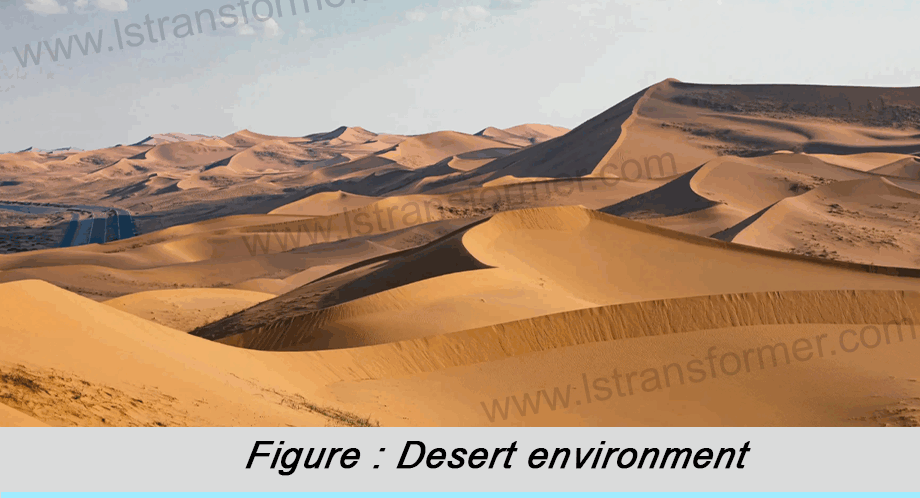
Long-term data reveals that without protection, radiator airflow channels in deserts can lose 40–60% of their cross-sectional area within 18 months, causing temperature rises of 20–30K and threatening transformer insulation life. Per IEEE Std C57.91-2011, the lifespan of oil-immersed transformers follows an exponential relationship with temperature—every 6°C increase doubles aging rates.
Design Type | Initial Pressure Drop (Pa) | Pressure Drop After 18 Months (Pa) | Temperature Rise (K) | Maintenance Cycle (Months) |
Standard Design | 120 | 310 | +28 | 6 |
Basic Anti-Sand | 150 | 240 | +15 | 12 |
Optimized Design | 180 | 210 | +8 | 24 |
Table 1: Performance comparison of radiators with varying protection levels in desert environments
2. Core Engineering Strategies for Anti-Sand Clogging Design
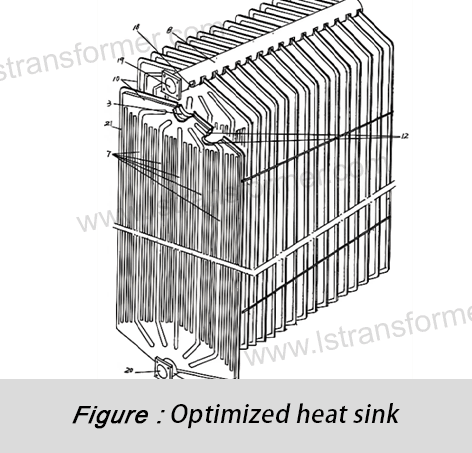
● Aerodynamically Optimized Cooling Channels
Aerodynamics is key to anti-sand design. Unlike traditional straight fins, desert-specific radiators use tapered flow channels based on Bernoulli’s principle and Stokes’ law.
Fin spacing: Wider at the inlet (12–15 mm vs. standard 6–8 mm) and narrower at the outlet (8–10 mm). This creates a progressive flow acceleration: lower inlet velocity (2–3 m/s) allows larger particles to settle, while higher outlet velocity (4–5 m/s) carries away finer dust. This design reduces sand accumulation by over 40%.
The optimized flow dynamics can be expressed as:
V₂ = V₁ × (A₁/A₂) × C_d
Where:
V₁, V₂ = Inlet/outlet velocity (m/s)
A₁, A₂ = Cross-sectional area (m²)
C_d = Flow shape coefficient (0.85–0.95)
Surface texture: Wavy or serrated fins create micro-vortices via boundary layer separation, disrupting particle adhesion and reducing sand buildup by 15–20%.
● Advanced Materials and Surface Engineering
Material selection impacts both corrosion resistance and dust adhesion. Modern designs use a three-layer composite:
(1)Base material:AA3003-H14 aluminum alloy (yield strength: 145 MPa) resists sand-induced micro-deformation better than standard AA1100 (90 MPa).
(2)Intermediate layer: Micro-arc oxidation forms a 10–15 μm porous Al₂O₃ ceramic layer (15–20% porosity), balancing thermal conductivity (~15 W/m·K) and hardness (HV ≥ 800).
(3)Functional coating: Fluoropolymer-modified siloxane lowers surface energy (18–22 mN/m, contact angle >110°), weakening van der Waals forces and reducing sand adhesion by 60%.
This composite adds minimal thermal resistance (0.0025 m²·K/W, <2% impact on cooling).
● Integrated Smart Self-Cleaning Systems
Modern designs combine real-time monitoring and automated cleaning:
(1)Monitoring:
-Differential pressure sensors (±5 Pa accuracy).
-Infrared thermography (0.1K resolution).
-Laser particle sensors (0.1–100 μm range).
(2)Cleaning mechanisms:
-Pulsed air jets (0.5–0.8 MPa, 50–100 ms pulses).
-Rotary carbon fiber brushes (30–60 rpm).
-Directional spray nozzles (5–8 L/min, 0.3 MPa).
(3)Control system:
-Fuzzy logic algorithms.
-Predictive maintenance using local sandstorm data.
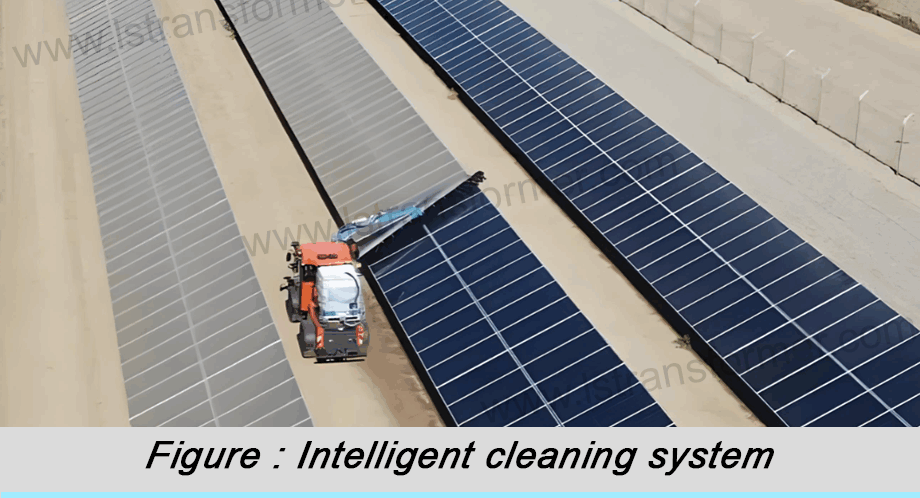
The system triggers cleaning when pressure drop rises by 15% or temperature increases by 5K, cutting manual maintenance by 70% and preventing 85% of overheating failures.
Cleaning Method | Efficiency (%) | Energy Use (kWh/cycle) | Coating Damage Risk | Use Case |
Manual Washing | 85–90 | 0.8 | Moderate | Routine maintenance |
Pulsed Air | 70–75 | 0.15 | Low | Frequent cleaning |
Rotary Brushes | 80–85 | 0.3 | High | Heavy sand buildup |
Combined Cleaning | 90–95 | 0.6 | Controlled | Quarterly deep cleaning |
Table 2: Comparison of cleaning methods for radiator performance
3. International Standards and Best Practices
Desert transformer designs must align with global and regional standards:
(1)IEC 60076-22-1:Specifies requirements for transformers in high-temperature climates (up to 50°C).
(2)IEEE Std C57.12.00-2015: Recommends IP55 or higher enclosures for dusty environments.
(3)ANSI/IEEE C57.96:Suggests derating transformers by 0.85–0.92 in deserts.
Middle Eastern benchmarks:
(1)Dubai (DEWA): Mandates 2,000-hour salt spray tests, ≤3-month self-cleaning cycles, and ≤20% fin clogging over 10 years.
(2)Saudi (SEC):Requires 500-hour accelerated sand aging tests (ISO 12103-1 A2 dust at 8 m/s), limiting pressure drop increase to ≤30%.
In Summary
Anti-sand clogging designs for desert transformers integrate aerodynamics, materials science, and smart controls. Emerging technologies like nanocoatings, self-healing materials, and AI-driven predictive maintenance will further enhance solutions in 5–10 years.
Key recommendations for operators:
(1)Treat anti-sand design as a system-level optimization, not an add-on.
(2)Conduct thermal performance assessments every 3 years.
(3)Update equipment per the latest standards.
With robust design and maintenance, desert transformers can achieve lifespans comparable to those in standard environments, supporting renewable energy and grid expansion.
Contact Us
LuShan, est.1975, is a Chinese professional manufacturer specializing in power transformers and reactors for50+ years. Leading products are single-phase transformer, three-phase isolation transformers,electrical transformer,distribution transformer, step down and step up transformer, low voltage transformer, high voltage transformer, control transformer, toroidal transformer, R-core transformer;DC inductors, AC reactors, filtering reactor, line and load reactor, chokes, filtering reactor, and intermediate,high-frequency products.
Our power transformers and reactors are widely used in 10 application areas: rapid transit, construction machinery, renewable energy, intelligent manufacturing, medical equipment, coal mine explosion prevention , excitation system, vacuum sintering(furnace), central air conditioning.
Know more about power transformer and reactor :www.lstransformer.com.
If you would like to obtain customized solutions for transformers or reactors, please contact us.
WhatsApp:+86 17267488565
Email:[email protected]