
 EN
EN
 FR
FR DE
DE ES
ES
Temperature Rise Limits of Dry-Type Transformers vs. Oil-Immersed Transformers: Key Differences
Temperature Rise Limits of Dry-Type Transformers vs. Oil-Immersed Transformers: Key Differences
In power systems, transformers are the core equipment for energy conversion and distribution, and their performance and reliability directly impact the safety of the grid. During operation, transformers generate heat, making temperature rise a critical performance indicator. Due to differences in cooling methods, dry-type transformers and oil-immersed transformers exhibit significant variations in their temperature rise limits. This article provides a detailed analysis of the standards, influencing factors, and underlying technical principles of these limits, helping power engineers, procurement professionals, and industry practitioners better understand this key parameter.
Globally, standards organizations such as IEEE, IEC, and ANSI have clearly defined temperature rise limits for transformers. By comparing these standards, we can better determine the most suitable transformer for different scenarios.
Content
1. Definition and Importance of Temperature Rise Limits
Temperature rise refers to the difference between the internal temperature of a transformer under rated load and the ambient temperature. For example, if the ambient temperature is 30°C and the winding temperature is 110°C, the temperature rise is 80K (note: the unit is Kelvin, K, not Celsius, °C).
Δθ = Tmeasured − Tambient
Example: Ambient temperature 40°C, winding temperature 110°C → Temperature rise = 70K.
Why is controlling temperature rise critical for system survival?
Impact Dimension | Mechanism | Quantified Consequences |
Insulation Aging | Follows Arrhenius Law: For every 8-10°C increase, insulation life halves. | H-class insulation at 180°C lasts 10 years → At 190°C, life reduces to 5 years (IEEE 98 Report). |
Load Capacity | Exceeding temperature rise triggers thermal protection, forcing derating. | Oil-filled transformers exceeding 5K see capacity drop ≥3% (IEC 60076-7). |
Failure Risk | Dry-type: Epoxy resin carbonization → Short circuit; Oil-filled: Oil decomposition → Explosive gas formation. | >65% of transformer failures originate from overheating (CIGRE statistics). |
2. Temperature Rise Limits for Dry-Type Transformers
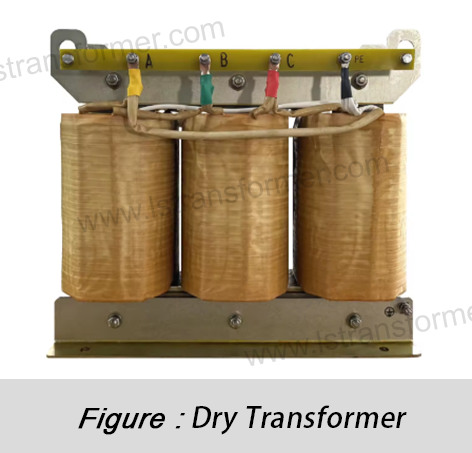
Dry-type transformers rely on air cooling, with insulation systems typically made of epoxy resin or Nomex® paper. Due to air's lower specific heat capacity and thermal conductivity, dry-type transformers have weaker heat dissipation, resulting in lower temperature rise limits.
According to IEC 60076-11 and IEEE C57.12.01, the temperature rise limits for dry-type transformers are as follows:
Insulation Class | Winding Temperature Rise Limit (K) | Hotspot Temperature Limit (°C) | Typical Applications |
A (105) | 60 | 105 | Older equipment |
E (120) | 75 | 120 | Rarely used |
B (130) | 80 | 130 | General-purpose |
F (155) | 100 | 155 | High-load demand |
H (180) | 125 | 180 | High-temperature environments |
● Why are dry-type transformer limits lower?
Dry-type transformers depend on air convection for cooling, and air's thermal conductivity (0.026 W/m·K) is far lower than transformer oil (0.12 W/m·K). To ensure insulation longevity, temperature rise limits must be strictly controlled. For example, an F-class (155°C) dry-type transformer allows a 100K rise but is often operated below 80K for reliability.
● Temperature rise calculation model for dry-type transformers
Temperature rise correlates exponentially with load:
Δθ = ΔθR × (I/IR)^1.6
ΔθR: Rated temperature rise (e.g., 100K)
I/IR: Load ratio
Example:An F-class dry-type transformer at 120% load:
Temperature rise = 100 × (1.2)^1.6 ≈ 135K (exceeds limit by 35%).
● Maintenance tips
(1)Spacing:Keep ≥300mm from walls (≥150mm for forced convection).
(2)Cleanliness: Dust buildup reduces cooling efficiency by 15-30%.
(3)Overloading: Limit to ≤3 daily overloads, spaced >4 hours apart (to avoid heat accumulation).
3. Temperature Rise Limits for Oil-Immersed Transformers
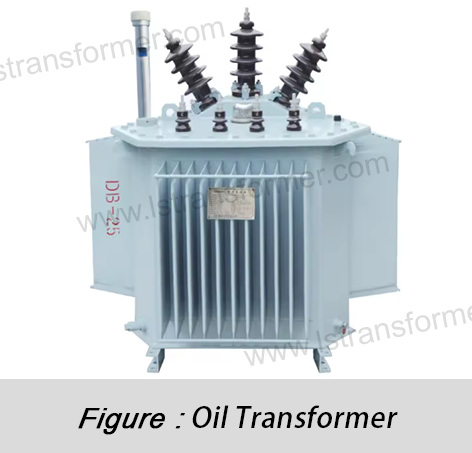
Oil-immersed transformers use mineral oil or synthetic esters for cooling and insulation. Oil's high specific heat capacity and forced circulation (e.g., ONAN/ONAF/OFAF cooling) enable superior heat dissipation, allowing higher temperature rise limits.
Per IEC 60076-2 and ANSI C57.12.00, oil-immersed transformer limits are:
Parameter | Temperature Rise Limit (K) | Notes |
Winding (avg.) | 65 (resistance method) | Typical for distribution transformers. |
Top oil | 55 | Prevents oil degradation. |
Hotspot | 78 | Critical limiting factor. |
Why higher limits for oil-immersed transformers?
(1)Oil’s cooling efficiency: Thermal conductivity (0.12 W/m·K) is 5× higher than air.
(2)Thermal stability: High-quality oil withstands >100°C long-term without breakdown.
(3)Forced cooling: Large units use fans (ONAF) or oil pumps (OFAF) to further reduce temperature rise.
4. Key Factors Influencing Temperature Rise
● Load profile
(1)Continuous load:Temperature stabilizes near design limits.
(2)Intermittent load:Short overloads may be buffered by thermal time constants (τ = 30-120 min), but must comply with IEC 60354 guidelines.
Tiered limits
Monitoring Point | Rise Limit (K) | Absolute Limit (°C) | Measurement Method |
Winding (avg.) | 65 | 105 | Resistance method |
Top oil | 55 | 95 | Thermometer |
Hotspot | 78 | 118 | Fiber-optic sensor |
Dynamic rise formula (IEC 60354)
Δθo = ΔθoR + τ × (dP/dt)
τ: Thermal time constant (small units ≈1.5h, large ≈3h).
dP/dt: Rate of loss change.
Application:Calculating temperature rise in wind farms with fluctuating loads.
Maintenance tips
(1)Oil level: Expansion rate ≈0.0007/°C → 40K rise increases volume by 2.8%.
(2)Oil quality:Acid value >0.1mg KOH/g reduces cooling efficiency by 12-18%.
(3)Cooling system:Fan failure raises ONAF-mode rise by 40%.
● Ambient temperature
IEEE defines "ambient" as 30°C annual average. In hot regions (e.g., Middle East), higher insulation classes (e.g., H-class) are required.
● Cooling methods
(1)Dry-type: AN (natural convection) or AF (forced air).
(2)Oil-immersed: ONAN/ONAF/OFWF. Forced cooling(3)reduces rise but increases energy use.
5. Temperature Rise Calculation and Monitoring
● Calculation formulas
Oil-immersed winding rise per IEC 60076-7:
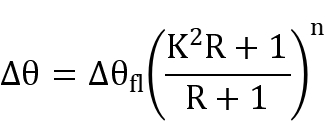
Where:
Actual rise
Full-load rise
Load ratio (actual/rated)
Copper/iron loss ratio
Empirical exponent (oil: n≈0.8; dry: n≈1.0)
● Real-time monitoring
Modern transformers use fiber-optic Distributed Temperature Sensing (DTS) or infrared thermography for hotspot tracking.
Technology | Accuracy | Location | Use Case |
Infrared | ±3°C | Winding surface | Periodic checks |
PT100 sensor | ±0.5°C | LV winding | Fixed real-time monitoring |
Advanced solutions for oil-immersed units
(1)Fiber-optic DTS:
–±1°C accuracy, 0.01°C resolution.
–Embedded in HV windings for 3D temperature mapping.
–Hotspot detection via Raman scattering:
ΔT = (c × Δϕ) / (4πL × α)
(α: Fiber coefficient).
(2)Dissolved Gas Analysis (DGA):
–C2H4 >50ppm indicates hotspots (>150°C).
In Summary
The difference in temperature rise limits between dry-type and oil-immersed transformers stems from the thermal performance gap between air and oil—air’s conductivity is just 1/5 of oil’s, and its specific heat is <1/2, forcing dry-types to adopt stricter limits (typically 80-100K vs. oil’s 65K avg./78K hotspot).
For indoor applications (e.g., data centers, commercial buildings), dry-types excel with maintenance-free, leak-proof designs but require forced cooling and H-class insulation. In harsh outdoor environments (e.g., power plants, offshore platforms), oil-immersed units leverage oil’s thermal mass and scalable cooling (OFAF/OFWF) for compact designs and extended overload tolerance.
Future innovations include:
(1)Dry-type: Nano-doped epoxy (e.g., AlN fillers boost conductivity by 40%).
(2)Oil-immersed: Bio-based insulating fluids (fire point >320°C) redefine safety margins.
For optimal selection, engineers should use IEC 60076-14 digital twin models to simulate local climate and load profiles, quantifying 20-year thermal aging losses to balance safety and cost.
Contact Us
LuShan, est.1975, is a Chinese professional manufacturer specializing in power transformers and reactors for50+ years. Leading products are single-phase transformer, three-phase isolation transformers,electrical transformer,distribution transformer, step down and step up transformer, low voltage transformer, high voltage transformer, control transformer, toroidal transformer, R-core transformer;DC inductors, AC reactors, filtering reactor, line and load reactor, chokes, filtering reactor, and intermediate,high-frequency products.
Our power transformers and reactors are widely used in 10 application areas: rapid transit, construction machinery, renewable energy, intelligent manufacturing, medical equipment, coal mine explosion prevention , excitation system, vacuum sintering(furnace), central air conditioning.
Know more about power transformer and reactor :www.lstransformer.com.
If you would like to obtain customized solutions for transformers or reactors, please contact us.
WhatsApp:+86 17267488565
Email:[email protected]