
 EN
EN
 FR
FR DE
DE ES
ES
What Special Certifications Must the Lead Wires of Electric Vehicle Charging Pile Transformers Meet?
What Special Certifications Must the Lead Wires of Electric Vehicle Charging Pile Transformers Meet?
With the rapid growth of the global electric vehicle (EV) market, the demand for charging infrastructure is increasing significantly. As one of the core components of a charging pile system, the design and performance of transformers and their lead wires directly impact the safety, efficiency, and reliability of the charging system. This article will explore in detail the special technical requirements that the lead wires of EV charging pile transformers must meet, helping you understand the design specifications and industry standards for this critical component.
Content
1. Why Do Charging Pile Transformer Lead Wires Have Special Requirements?
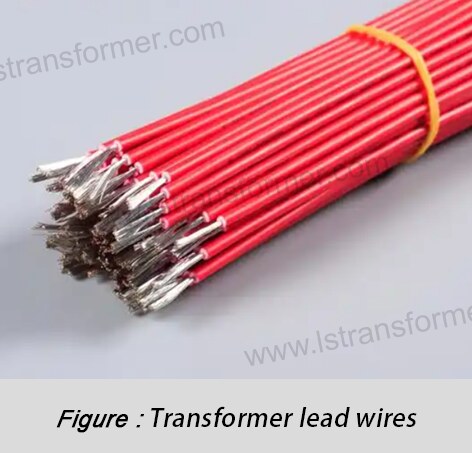
Charging pile transformers differ significantly from traditional power transformers in terms of operating conditions and performance requirements. These differences stem primarily from the dynamic nature of the charging process and the unique demands of EV charging (EV charging requirements).
● Frequent Load Fluctuations
Unlike traditional transformers, which operate under relatively stable loads, charging pile transformers experience rapid and drastic load changes during vehicle connection, charging mode transitions (e.g., from constant current to constant voltage), and charging termination. These dynamic changes subject the lead wires to greater mechanical and thermal stress.
● High Power Density Challenges
High power density is a defining feature of modern fast-charging piles (DC fast charger transformer). Current mainstream fast chargers already deliver 350 kW or more (e.g., Tesla’s V4 Supercharger), with future systems targeting megawatt levels. Efficient energy transfer and temperature control in such high-power systems require well-designed lead wires.
● Diverse Environmental Conditions
Charging piles are often installed in varied environments, from extremely cold regions to tropical climates, and from arid deserts to coastal areas with high humidity. Lead wires must exhibit excellent environmental resistance (Environmental resistance) to withstand temperature variations, humidity, UV radiation, and other challenges.
● Strict Safety Standards
Safety standards such as IEC 61851 and UL 2202 impose stringent requirements on charging pile transformers and their lead wires, particularly regarding insulation performance, voltage resistance, and fire safety. These standards ensure user and operational safety while guiding the material and structural design of lead wires.
2. Key Special Requirements for EV Charging Pile Transformer Lead Wires
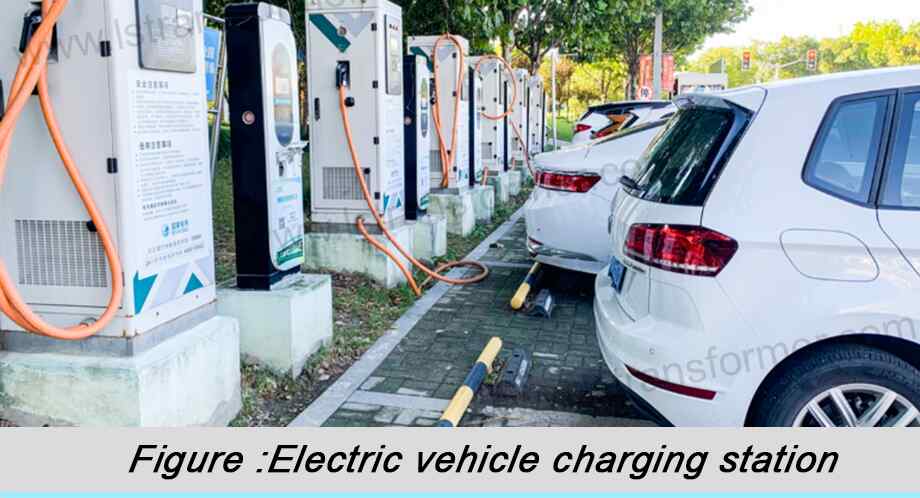
● High-Temperature Resistance and Thermal Stability
The lead wires of charging pile transformers must withstand prolonged high-temperature operation (High temperature operation). During fast charging, high currents generate significant Joule heat (I²R losses), and combined with ambient temperatures, conductor temperatures can exceed 90°C.
Thermal stability (Thermal stability) is achieved through the following design considerations:
(1)Conductor Material Selection: Oxygen-free copper (OFC) is the preferred choice due to its high conductivity and low resistivity, with a temperature coefficient of approximately 0.00393/°C. Compared to standard copper, OFC exhibits less resistance increase under high heat, reducing additional heating.
(2)Insulation Material Temperature Rating: Lead wire insulation typically uses cross-linked polyethylene (XLPE) or silicone rubber, with temperature ratings of at least 105°C (Class A) or higher (e.g., Class F-155°C, Class H-180°C). Material thermal aging characteristics are tested per IEC 60216 standards.
(3)Heat Dissipation Design: Large cross-section lead wires (typically ≥50 mm²) reduce current density, while specialized stranding (e.g., compact or sector-stranded) increases surface area for heat dissipation. Proper design can limit temperature rise to below 50K (relative to ambient temperature).
Insulation Material Type | Temperature Rating | Maximum Continuous Use Temperature | Short-Term Overload Capacity | Typical Applications |
PVC (Polyvinyl Chloride) | 70°C (Class Y) | 70°C | 90°C (max) | Low-end AC slow chargers |
XLPE (Cross-Linked Polyethylene) | 90°C (Class A) | 105°C | 130°C | Mainstream fast chargers |
Silicone Rubber | 180°C (Class H) | 180°C | 250°C | High-power-density fast charging systems |
PTFE (Polytetrafluoroethylene) | 250°C (Class C) | 250°C | 300°C | Extreme environments (military/special charging equipment) |
Table 1: Comparison of Temperature Resistance Properties for Different Insulation Materials
● Mechanical Strength and Vibration Resistance
Charging pile transformer lead wires face multiple mechanical stresses. Installation involves unavoidable bending and stretching, while operational electromagnetic vibrations (caused by high-current alternating magnetic fields) subject the wires to continuous mechanical fatigue risks.
To ensure long-term reliability (Long-term reliability), lead wire designs must meet the following:
(1)Conductor Stranding Structure: Layered stranding with multiple fine copper strands (e.g., compliant with IEC 60228 Class 5 or 6) is used instead of single thick wires. This structure offers superior flexibility and bending fatigue resistance, with tests showing a 3-5x lifespan increase over solid conductors of the same cross-section.
(2)Vibration Resistance Design:Electromagnetic force frequency is calculated as f=(2×I×B)/L (I = current, B = magnetic flux density, L = length) to identify potential resonance points. Countermeasures include:
– Limiting support point spacing to safe values:
L_max=√(T/(m×f²))
(T = tension, m = mass per unit length)
– Using damping materials for wrapping or clamping
– Implementing elastic buffer designs at fixation points
(3)Connection Reliability: Cold crimping is typically used for terminal connections, with contact resistance R_c ≤ 1.1R_0 (R_0 = conductor resistance for the same length). Crimp quality is verified using micro-ohmmeters to ensure no loosening under vibration.
● Electrical Insulation and Voltage Resistance
The insulation system of charging pile transformer lead wires must handle complex electrical environments. In addition to standard power frequency voltages (e.g., 480V or 690V systems), the wires must endure high-frequency harmonics (from AC/DC conversion) and transient overvoltages (e.g., switching operations or lightning surges).
Key parameters for insulation performance (Insulation performance) include:
(1)Partial Discharge:Per IEC 60885-3, partial discharge must be ≤10 pC at 1.5x rated voltage. Triple-layer co-extruded insulation (conductor shield-main insulation-insulation shield) reduces discharge by over 60% compared to single-layer designs.
(2)Dielectric Loss Tangent (tanδ):High-quality XLPE insulation should have tanδ ≤0.005 at 90°C and 50Hz. Excessive tanδ causes insulation heating and thermal breakdown. Additives like nano-magnesium oxide improve this parameter.
(3)Impulse Voltage Resistance: Per IEC 60071-1, lead wires must withstand:
– Lightning Impulse (1.2/50μs waveform): 6 kV for 690V systems
– Switching Impulse (250/2500μs waveform): 4 kV for the same systems
Semiconducting shields (Semiconducting shield) are critical for uniform electric field distribution, reducing maximum field strength by 30-40% (calculated as E=V/(r×ln(R/r)), where V = voltage, r = conductor radius, R = insulation outer diameter).
● Electromagnetic Compatibility (EMC) and Harmonic Suppression
Modern fast chargers use high-frequency switching topologies (e.g., LLC resonant converters) operating at 50kHz–150kHz. This high frequency can make lead wires sources of electromagnetic interference (EMI) while also requiring EMI resistance.
Key EMC design (EMC design) measures include:
(1)Dual-Layer Shielding:
– Inner Layer: Copper braid shield (≥85% coverage) for low-frequency interference (<1 MHz)
– Outer Layer:Aluminum-plastic composite foil for high-frequency interference (>1 MHz)
– Tests show dual shielding reduces radiated noise by over 20 dB compared to single shielding.
(2)Magnetic Core Filtering: Nanocrystalline magnetic rings (e.g., Fe-based amorphous cores) are installed at strategic points. Their impedance Z=√(R²+(2πfL)²) (R = equivalent resistance, L = equivalent inductance) absorbs high-frequency noise.Selection criteria include:
– Initial permeability μ_i ≥20,000
– Saturation flux density B_s ≥1.2 T
– Operating frequency range covering 3-5x the charger’s switching frequency harmonics
(3)Symmetrical Wiring: For three-phase lead wires, tightly twisted symmetrical arrangements (vs. parallel layouts) cancel magnetic fields, reducing external field strength to 10%-15% of parallel designs.
● Environmental Adaptability and Chemical Stability
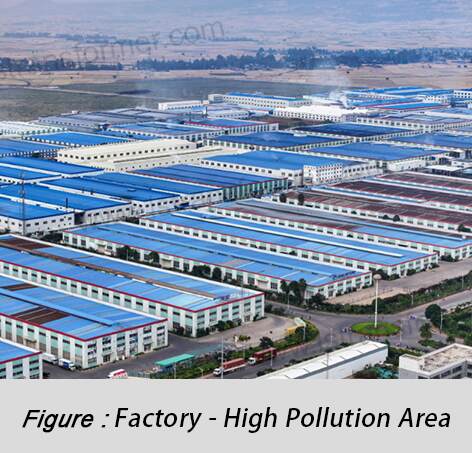
Charging pile transformer lead wires face harsher environmental stresses than typical industrial settings. Salt spray in coastal areas, chemical corrosion in industrial zones, and UV radiation in deserts accelerate material aging.
Strategies to enhance environmental resistance (Environmental resistance):
(1)UV Resistance: Adding carbon black (2.5%-3%) or UV stabilizers (e.g., hindered amine light stabilizers, HALS) extends outdoor service life from 2-3 years to over 10 years (per ASTM G154 testing).
(2)Waterproof Sealing: Radial waterproof designs include:
– Conductor gaps filled with waterproof gel (e.g., polyurethane sealant)
– Insulation shield wrapped with water-blocking tape
– Outer sheath with longitudinal water resistance (e.g., aluminum-plastic composite film)
– IEC 60502-2 Annex D immersion tests (10 days, 1m depth at 20°C) require insulation resistance ≥1000 MΩ·km.
(3)Chemical Resistance:Sheath materials like oil-/acid-resistant PVC or TPE are preferred. Per ISO 6722, after 48h immersion in fuel at 70°C, tensile strength retention must be ≥70%, and elongation retention ≥65%.
3. International Standards and Certification Requirements
EV charging pile transformer lead wires must comply with international standards and regional certifications (International standards and certifications), including:
(1)IEC 62993: The latest global standard for EV charging cables, specifying:
– Rated voltage: 300/500V to 18/30kV
– Bending radius: ≥4D for fixed installation, ≥6D for movable use (D = cable diameter)
– Oil resistance: ≤50% volume change after 7 days in IRM 902 oil
(2)UL 2202:North American standard emphasizing:
– Fire resistance: UL 1685 vertical tray test
– Smoke density: NFPA 262 test, max optical density ≤0.5
– Toxic gas emission: NBS smoke chamber test, HCl release ≤5%
(3)EN 50620:European standard with additional requirements:
– Cold flexibility: No cracking at -40°C in wrap tests
– Mechanical impact: Insulation resistance ≥0.1 MΩ after 1kg hammer drop from 1m
– Eco-compliance: RoHS and REACH regulations
(4)GB/T 33594:Chinese national standard specifying:
– DC withstand voltage: 5x rated voltage for 5 minutes without breakdown
– Thermal cycling: 20 cycles (-40°C to 120°C) without performance degradation
– Load cycling: After 1000 full-load (Imax) cycles, temperature rise must not exceed initial value by 10%
Future Trends and Technological Innovations
As charging technology advances toward ultra-high power (e.g., Tesla’s V4 Supercharger at 1000V/500A) and smart features, transformer lead wire technology is also evolving:
● Superconducting Applications: High-temperature superconducting (HTS) lead wires, such as YBCO tapes, achieve current densities of 100A/mm² at 77K (50x copper’s capacity). Though requiring cooling systems, they reduce losses by over 90%.
● Integrated Smart Monitoring: Next-gen lead wires embed fiber-optic sensors (e.g., FBG) for real-time monitoring of:
– Temperature (±0.5°C accuracy)
– Strain (1με resolution)
– Partial discharge (5pC sensitivity)
Data is transmitted via protocols defined in IEC 62485-3.
● Eco-Friendly Materials:Bio-based insulation (e.g., polyhydroxyalkanoates, PHA) and biodegradable sheaths aim to cut lifecycle carbon footprints by 60% while maintaining electrical performance.
In Summary
The lead wires of EV charging pile transformers, as critical energy transmission channels, must balance electrical, mechanical, thermal, and environmental factors. From high-temperature resistance to EMC design, and from mechanical strength to chemical stability, each requirement directly impacts charging system safety and efficiency. With advancing standards and new materials, lead wire technology will continue to innovate, ensuring reliable operation for EV charging infrastructure.
Choosing high-quality lead wire products compliant with international standards (e.g., UL or IEC-certified solutions) not only ensures regulatory compliance but also reduces lifecycle maintenance costs. Charging pile manufacturers are advised to collaborate closely with professional transformer suppliers to customize optimal lead wire solutions for specific applications, driving sustainable growth in the EV industry.
Contact Us
LuShan, est.1975, is a Chinese professional manufacturer specializing in power transformers and reactors for50+ years. Leading products are single-phase transformer, three-phase isolation transformers,electrical transformer,distribution transformer, step down and step up transformer, low voltage transformer, high voltage transformer, control transformer, toroidal transformer, R-core transformer;DC inductors, AC reactors, filtering reactor, line and load reactor, chokes, filtering reactor, and intermediate,high-frequency products.
Our power transformers and reactors are widely used in 10 application areas: rapid transit, construction machinery, renewable energy, intelligent manufacturing, medical equipment, coal mine explosion prevention , excitation system, vacuum sintering(furnace), central air conditioning.
Know more about power transformer and reactor :www.lstransformer.com.
If you would like to obtain customized solutions for transformers or reactors, please contact us.
WhatsApp:+86 13787095096
Email:[email protected]