






How to Choose Reactor Core Materials? — Comprehensive Guide to Silicon Steel, Ferrite, and Amorphous Alloys
How to Choose Reactor Core Materials?
— Comprehensive Guide to Silicon Steel, Ferrite, and Amorphous Alloys
In power systems, new energy inverters, and industrial frequency conversion equipment, “reactor core material selection” is a critical decision affecting efficiency, size, and cost. According toIEEE 389 standards, core materials directly determine 40%-60% of reactor losses. This article, based onIEC 60404 andASTM A927 international standards, systematically analyzes the magnetic properties of silicon steel, ferrite, and amorphous alloys, providing a global engineering selection guide.
Content
1. Key Performance Parameters and Selection Logic
1.1 Core Performance Indicators
The core parameters of magnetic materials determine reactor size, efficiency, and temperature rise:
1.1.1 Saturation Flux Density (Bsat):
(1) Definition:Maximum magnetic flux density a material can withstand (unit: Tesla, T).
(2) Impact: Higher Bsat reduces core volume for the same inductance
Formula:
For example, increasing Bsat from 1.5T to 2.0T reduces volume by 25%.
1.1.2 Permeability (μ):
(1) Definition: Material’s ability to conduct magnetic flux, determining inductance
Formula:
(2) Impact:High μ reduces coil turns, lowering copper losses and costs.
1.1.3 Loss Density (Pv):
(1) Definition: Hysteresis and eddy current losses per unit volume
Formula:
(2) Impact: Lower Pv improves efficiency and temperature control (IEC 60076-14 requires ΔT ≤65K).
1.2 Material Selection Matrix
| Key Requirement | Material Property | Suitable Material |
| High-frequency (>10kHz) | Low loss (Pv <5W/m³) | Ferrite (Mn-Zn/Ni-Zn) |
| High current (>100A) | High Bsat (≥1.8T) | Silicon Steel (Grain-Oriented) |
| Energy efficiency | Ultra-low loss (Pv <1W/kg) | Amorphous Alloy |
| Cost-sensitive projects | Cost-effective | Silicon Steel (Non-oriented) |
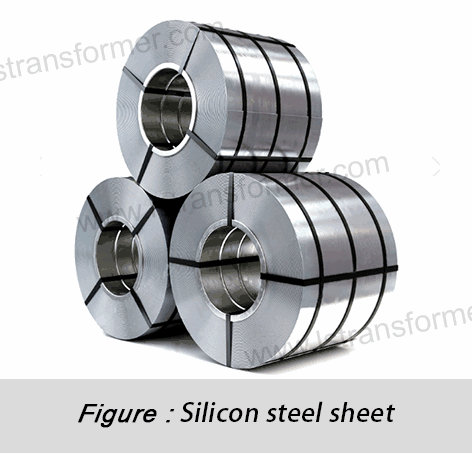
2. Silicon Steel: High Power Density & Cost Efficiency
2.1 Properties & Advantages
(1) High Bsat (1.8–2.0T): Silicon addition (2%-3.5%) increases resistivity, reducing eddy current losses.
(2) Grain-Oriented (GO) Technology: Aligns grains during rolling, boosting permeability for power-frequency applications.
2.2 Pros vs. Cons
| Pros | Cons | Applications |
| Low cost (60% cheaper than amorphous) | High losses at >1kHz | Power-frequency reactors (wind/solar) |
| High mechanical strength (≥300MPa) | Lower μ than amorphous alloys | High-current filters (IEC 61800-9-2) |
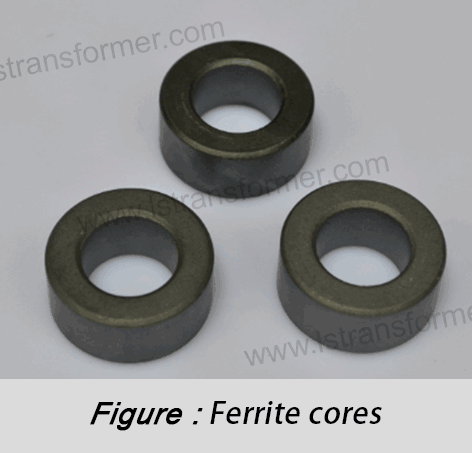
3. Ferrite: Low-Loss Solution for High Frequencies
3.1 Properties & Advantages
(1) Low High-Frequency Losses: Mn-Zn ferrite resistivity minimizes eddy currents.
(2) High μ: Optimized microstructure suits high-frequency inductors (e.g., SMPS).
3.2 Pros vs. Cons
| Pros | Cons | Applications |
| >98% efficiency at >10kHz | Low Bsat (0.3–0.5T) | Server PFC inductors (EN 62368-1) |
| Compact size (50% smaller than silicon steel) | Brittle (prone to cracking) | Telecom transformers |
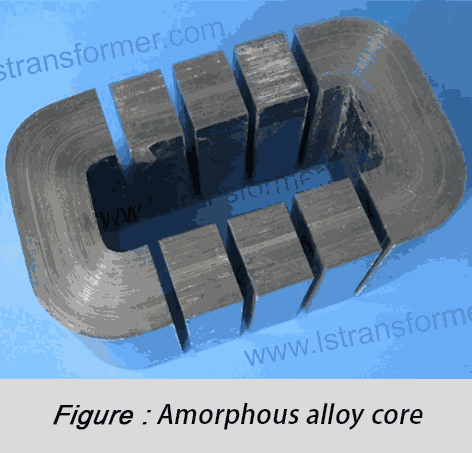
4. Amorphous Alloy: Ultra-Low Loss & Eco-Friendly
4.1 Properties & Advantages
(1) Ultra-Low Hysteresis Loss: Disordered atomic structure reduces losses to 1/5 of silicon steel.
(2) Sustainability: 80% lower energy in manufacturing (ASTM A927 LCA).
4.2 Pros vs. Cons
| Pros | Cons | Applications |
| 70% lower loss than silicon steel | High material cost (2–3× silicon steel) | Solar inverters (IEC 61683) |
| Low temperature rise (ΔT ≤40K) | Difficult machining (special tools) | Energy-efficient reactors (IEC 60076-20) |
In Summary
Conclusion Silicon steel, ferrite, and amorphous alloys require balancing frequency, power density, and lifecycle costs. Amorphous alloys excel in energy-efficient power-frequency applications, while ferrite dominates high-frequency designs. For IEC/IEEE/EN-compliant solutions, contact our technical team for end-to-end services from simulation to prototyping.
Contact
LuShan, est. 1975, is a Chinese professional manufacturer specializing in power transformers and reactors for 50+ years. Leading products are single-phase transformer, three-phase isolation transformers, electrical transformer, distribution transformer, step down and step up transformer, low voltage transformer, high voltage transformer, control transformer, toroidal transformer, R-core transformer; DC inductors, AC reactors, filtering reactor, line and load reactor, chokes, filtering reactor, and intermediate, high-frequency products.
Our power transformers and reactors are widely used in 10 application areas: rapid transit, construction machinery, renewable energy, intelligent manufacturing, medical equipment, coal mine explosion prevention, excitation system, vacuum sintering(furnace), central air conditioning.
Know more about power transformer and reactor: www.lstransformer.com.
If you would like to obtain customized solutions for transformers or reactors, please contact us.
WhatsApp:+86 13787095096
Email: marketing@hnlsdz.com

