
 EN
EN
 FR
FR DE
DE ES
ES
What Tests Should Be Conducted After a Sudden Short Circuit? —Winding Deformation Testing (FRA Method) Operational Procedure
What Tests Should Be Conducted After a Sudden Short Circuit?
—Winding Deformation Testing (FRA Method) Operational Procedure
Transformers are the core equipment of power systems, and their safe and stable operation is critical. When a transformer experiences a sudden short-circuit fault, its windings may undergo mechanical deformation invisible to the naked eye. If these potential damages are not detected promptly, they can lead to degraded insulation performance, increased partial discharge, and ultimately catastrophic failure. According to International Electrotechnical Commission (IEC) standards and State Grid Corporation statistics, winding deformation is one of the primary causes of transformer failures after short circuits. This article details how to scientifically assess winding conditions using the Frequency Response Analysis (FRA) method, an internationally recognized detection technique, to provide reliable data for subsequent maintenance decisions.
Content
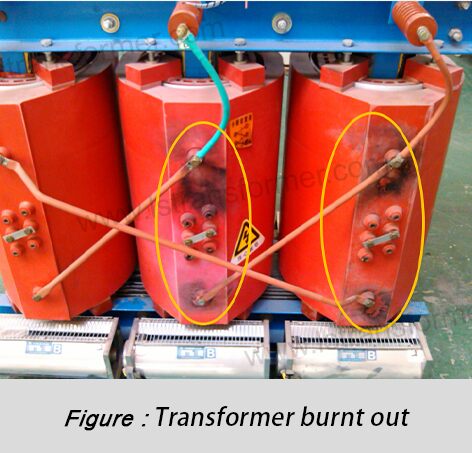
1. The Impact Mechanism of Sudden Short Circuits on Transformer Windings
● Principles of Short-Circuit Electrodynamic Forces
During a short circuit (especially a three-phase short circuit), the windings carry instantaneous short-circuit currents 10–25 times higher than the rated current. According to Ampere’s force law (F = BIL), these currents generate enormous mechanical stress under the influence of leakage magnetic fields. The forces can be categorized into two types:
(1) Radial forces:Compress the inner winding inward and expand the outer winding outward.
(2)Axial forces: Cause compression or stretching deformation at the winding’s upper and lower ends.
The instantaneous peak force can reach tens of tons, far exceeding the winding’s design strength, leading to the following typical deformation patterns:
Deformation Type | Cause | Potential Consequences |
Radial deformation | Radial electrodynamic force exceeds support structure strength | Altered main insulation distance, increased partial discharge |
Axial distortion | Uneven axial force distribution or spacer displacement | Higher risk of inter-turn short circuits |
Local depression | Conductor yielding or support bar fracture | Hotspot formation, accelerated insulation aging |
● The Development Process of Winding Deformation
Winding deformation after a short circuit typically progresses through three stages:
(1)Instantaneous elastic deformation:Recoverable deformation at the moment of short circuit, which may not be detectable in tests.
(2)Plastic deformation stage: Permanent deformation occurs when the material’s yield point is exceeded.
(3)Cumulative damage effect:Repeated short circuits cause deformation to accumulate, eventually leading to insulation failure.
Research by the International Council on Large Electric Systems (CIGRE) shows that approximately 68% of transformers exhibit measurable winding deformation after severe short circuits, with 30% developing into serious faults during subsequent operation.
2. Technical Principles of FRA for Detecting Winding Deformation
● Basic Concepts of Frequency Response Analysis
The Frequency Response Analysis (FRA) method evaluates the mechanical condition of transformer windings by measuring changes in their impedance characteristics across different frequencies. The theoretical basis is:
A winding can be modeled as a distributed network of inductance (L), capacitance (C), and resistance (R). Its frequency response function H(f) is expressed as:
H(f) = Vout(f)/Vin = Zw/[Zs+Zw]
Where Zw is the winding impedance, and Zs is the signal source impedance.
When physical deformation occurs, the distributed parameters L and C change, causing shifts in the response curve’s characteristic frequency points. By comparing historical data and phase-to-phase data, the location and extent of deformation can be precisely identified.
● Advantages of the FRA Method
Compared to traditional methods, FRA offers the following key benefits:
(1)High sensitivity:Detects minor capacitance changes as small as 0.1%.
(2)Non-destructive: Test voltage is typically <10V, ensuring no damage to insulation.
(3)Full-frequency analysis: Covers 1kHz–1MHz, reflecting information at different depths.
(4)Quantitative evaluation:Uses metrics like correlation coefficient (CC) and mean squared error (MSE) for objective assessment.
According to IEEE Std C57.156-2016, the FRA method achieves over 95% accuracy in detecting winding deformation and has become a mandatory testing procedure for power companies in Europe and the U.S.
3. Standardized FRA Testing Procedure (Compliant with IEC 60076-18)
● Core Preparations
(1)Safety isolation:Implement Lockout-Tagout (LOTO) procedures to ensure the transformer is completely de-energized and grounded (residual voltage <50V).
(2)Remove all external connections, especially bushing tap leads, to avoid signal interference. This step eliminates 90% of on-site testing errors.
Environmental Controls
(1)Temperature:Record ambient temperature (refer to IEEE C57.152 standard).
(2)Humidity:≤85% (high humidity increases surface leakage current).
(3)Electromagnetic interference:Conduct tests 2 hours after power-off (to avoid system overvoltage).
● Key Wiring Configuration Options
Wiring Type | Application Scenario | International Standard Reference |
End-to-end method | Comprehensive diagnosis (recommended post-short circuit) | IEC 60076-18 Annex B |
Capacitive coupling method | Rapid on-site screening | CIGRE TB 642 |
Inductive voltage method | Specialized axial deformation detection | IEEE P1898 |
Key steps:Prioritize the end-to-end method—connect the signal source to the high-voltage bushing and the measurement terminal to the neutral grounding end (as shown in Figure 1). Wiring resistance must be <0.5Ω to avoid distorting low-frequency curves.
● Smart Parameter Settings
fmax = 150 / MVA Rating (MHz)
(1)Frequency range: 1kHz – [calculated value] MHz (e.g., 1.5MHz for a 100MVA transformer).
(2)Scan density: ≥800 points (logarithmic distribution, automatically denser in high-frequency ranges).
(3)Excitation voltage: 10V (balances signal-to-noise ratio and safety).
(4)Signal processing: Apply Hanning window + 32-time averaging (suppresses random noise).
4. Data Analysis and Intelligent Diagnosis (Based on IEEE C57.156)
● Core Diagnostic Metrics
Metric | Formula | Deformation Sensitivity | Threshold |
CC | ∑(xi−x̄)(yi−ȳ)/σxσy | Overall deformation | <0.95 (warning) |
RMSD | √[1/N ∑(Htest−Href)²] | Local distortion | >3dB (abnormal) |
ASL | ∫ | logH1(f)−logH2(f) | df |
● Typical Fault Signature Patterns
Deformation Type | Low Freq. (1–10kHz) | Mid Freq. (10–500kHz) | High Freq. (>500kHz) |
Radial expansion | Resonance peak shifts right ≥5% | Amplitude drops >3dB | No significant change |
Axial displacement | Phase lag >10° | Double-peak splitting | New resonance points |
Local collapse | No notable change | Narrow-band drop (>6dB) | Nonlinear phase jumps |
In Summary
Winding deformation testing (FRA method) is the gold standard for post-short-circuit transformer condition assessment. Its scientifically standardized implementation is crucial for ensuring equipment safety. This article provides a comprehensive guide covering test preparation, on-site execution, and data analysis. It is important to note that FRA result accuracy heavily depends on procedural compliance and the completeness of reference data. Companies are advised to establish a full lifecycle FRA database and align with international standards (e.g., IEC 60076-18) to maximize the technology’s value. For critical substations, online FRA monitoring systems can enable real-time winding condition tracking, preventing potential failures at an early stage.
Contact Us
LuShan, est.1975, is a Chinese professional manufacturer specializing in power transformers and reactors for50+ years. Leading products are single-phase transformer, three-phase isolation transformers,electrical transformer,distribution transformer, step down and step up transformer, low voltage transformer, high voltage transformer, control transformer, toroidal transformer, R-core transformer;DC inductors, AC reactors, filtering reactor, line and load reactor, chokes, filtering reactor, and intermediate,high-frequency products.
Our power transformers and reactors are widely used in 10 application areas: rapid transit, construction machinery, renewable energy, intelligent manufacturing, medical equipment, coal mine explosion prevention , excitation system, vacuum sintering(furnace), central air conditioning.
Know more about power transformer and reactor :www.lstransformer.com.
If you would like to obtain customized solutions for transformers or reactors, please contact us.
WhatsApp:+86 17267488565
Email:[email protected]