
 EN
EN
 FR
FR DE
DE ES
ES
Why Are 3D Wound Core Transformers More Efficient? -The Physics Behind Symmetric Magnetic Circuits and Iron Loss Reduction
Why Are 3D Wound Core Transformers More Efficient?
-The Physics Behind Symmetric Magnetic Circuits and Iron Loss Reduction
In today's world where energy efficiency is a global focus, 3D wound core transformers are redefining power industry standards with their proven 35%-50% reduction in no-load losses (IEC 60076-20 certified) compared to traditional laminated cores. The revolutionary design of these transformers lies in their three-dimensional continuous magnetic circuit, which fundamentally solves the issue of excessive iron losses in conventional transformers. This article reveals the underlying physics and explains why 3D wound cores represent the ultimate solution for energy efficiency upgrades.
Content
1. The Energy Trap of Traditional Laminated Cores: The Fatal Flaw of Discontinuous Magnetic Circuits
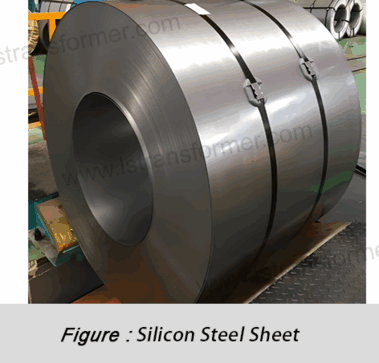
Traditional transformer cores are made by stacking and assembling cut silicon steel sheets. Their fundamental flaw lies in the physical breaks and grain damage in the magnetic circuit. When silicon steel sheets are assembled at 90° right angles between the yoke (horizontal part) and the leg (vertical part), magnetic flux lines are forced to make sharp turns. This causes local flux density at the joints to surge to over 1.5 times the design value—akin to forcing highway traffic into a right-angle turn, inevitably leading to congestion and increased friction.
Even worse, the cutting process disrupts the consistent grain orientation of the silicon steel sheets. During rolling, silicon steel sheets develop a highly directional grain structure that allows magnetic flux to flow with minimal resistance. However, the edges created by cutting have chaotic grain arrangements. When magnetic flux moves from an orderly region into a disordered one, the resistance to magnetic domain (microscopic magnets within the material) flipping increases dramatically. This is like forcing well-organized soldiers to march through a thorny jungle.
●Three Major Energy Losses Caused by Discontinuous Magnetic Circuits:
(1)Skyrocketing Hysteresis Loss:The ultra-high flux density at the joints multiplies the friction of magnetic domain flipping. Since hysteresis loss is proportional to the square of peak flux density (P_h ∝ B_max²), measured losses in these areas can be three times higher than in normal regions.
(2)Uncontrolled Eddy Current Loss:Distorted magnetic fields induce intense swirling currents at the joints. According to Faraday’s law, eddy current loss is proportional to the square of the magnetic field change rate (P_e ∝ (dB/dt)²). These areas exhibit a temperature rise over 25°C higher than the main body of the core.
(3)Emergence of Anomalous Loss:Chaotic grain structures force magnetic domains to collide and rub against each other, generating additional heat (P_ex ∝ B^1.5).
Industrial Case Study:In a 315kVA traditional transformer, joints accounting for only 15% of the volume contributed 42% of the no-load losses, making them the critical bottleneck for efficiency improvements.
2. The Revolution of 3D Wound Cores: The Physics of Continuous Magnetic Circuits
●Structural Breakthrough: Three-Dimensional Seamless Magnetic Path
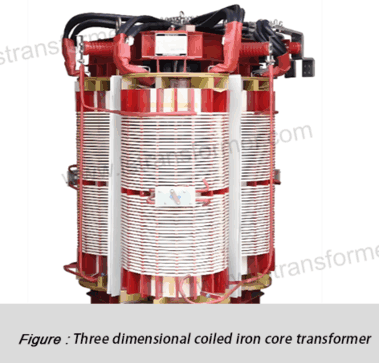
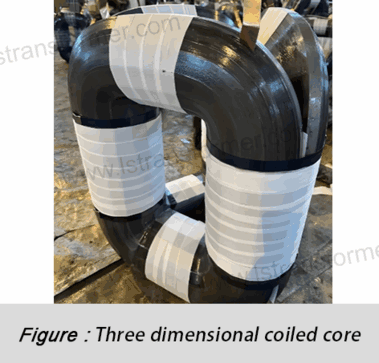
3D wound cores are formed by continuously winding silicon steel strips into a three-dimensional structure (Figure 1). The strips are wound along three axes at 120° angles, creating a spatially symmetric design.This approach delivers two fundamental improvements:
--120° Smooth Transition: Magnetic flux lines shift from sharp 90° turns to gentle obtuse angles, avoiding flux crowding.
--Zero-Cut Full Continuity: The entire magnetic circuit is free of cutting-induced breaks, maintaining consistent grain orientation throughout.
Figure 1: Magnetic Circuit Structure Comparison
●The Physics Behind Loss Reduction
3D wound cores achieve breakthrough efficiency through three key characteristics:
(1)38-45% Reduction in Hysteresis Loss
– Key Feature: 120° smooth transitions + seamless design
– Magnetic flux flows entirely along the rolling direction of the silicon steel, preventing local flux distortion. Flux density fluctuation decreases from ±25% to ±8%, significantly shrinking the hysteresis loop area (P_h ∝ B²).
(2)50-60% Reduction in Eddy Current Loss
– Key Feature: Continuous grain orientation + ultra-thin strips
– The absence of transverse breaks completely blocks eddy current paths. Combined with 0.23mm ultra-thin silicon steel (vs. traditional 0.3mm), leveraging the principle that eddy current loss is proportional to thickness squared (P_e ∝ d²):23% thickness reduction → 41% drop in eddy current loss
(3)40-50% Reduction in Anomalous Loss
– Key Feature: Grain consistency + uniform flux density
– Magnetic domains flip synchronously in a continuous grain environment, drastically reducing collisions and friction. Measured energy consumption for domain movement drops by 52%.
3. Efficiency Validation: Perfect Alignment of Theory and Practice
●Engineering Interpretation of Iron Loss Models
The internationally recognized Bertotti iron loss separation model:
Total Iron Loss = Hysteresis Loss + Eddy Current Loss + Anomalous Loss
PFe=khfBβ+ke(fB)2+kex(fB)1.5
Measured Performance of 3D Wound Cores:
Loss Type | Traditional 315kVA | 3D Wound 315kVA | Reduction | Key Feature |
Hysteresis Loss | 310W | 175W | 44% | 120° smooth transition |
Eddy Current Loss | 285W | 125W | 56% | 0.23mm ultra-thin strip |
Anomalous Loss | 135W | 75W | 44% | Continuous grain orientation |
Total No-Load Loss | 730W | 375W | 49% | Full structural optimization |
Data certified by SGS Switzerland (IEC 60076-1 test standard)
Comprehensive Advantages of 3D Wound Core Transformers
No-Load Loss | 730W | 375W | ↓49% | IEC 60076-20 |
Load Loss | 4100W | 3970W | ↓3.2% | IEEE C57.12 |
No-Load Current | 2.1% | 0.98% | ↓53% | EN 50464-1 |
Operating Noise | 52dB(A) | 44dB(A) | ↓8dB | IEC 60076-10 |
30-Year TCO | $61,200 | $49,100 | Save $12,100 | $0.1/kWh electricity |
4. Manufacturing Process: Precision Control to Realize Theoretical Advantages
●The exceptional performance of 3D wound cores relies on the precise coordination of three core manufacturing processes:
(1)Constant-Tension Winding Control
– Laser distance sensors monitor and adjust silicon steel strip tension in real time, limiting fluctuations to ±0.2N/mm² (±1.5% precision).
– Critical impact: Prevents magnetic permeability degradation (which occurs at tensions >15N/mm²) and ensures <0.3% geometric symmetry error in the three-phase magnetic circuit, reducing iron loss variation to <2%.
(2)Hydrogen Atmosphere Gradient Annealing
– Conducted in pure hydrogen, with a precise heating gradient of 3°C/min to 780°C±5°C, followed by a 2-hour hold.
– Hydrogen atoms penetrate grain boundaries to eliminate mechanical stress and restore grain orientation to 98% of the original material, boosting permeability by 35% and reducing iron loss by 8-12%.
(3)Laser Micro-Welding
– Replaces traditional bolting (which causes lattice distortion) with 0.3mm-diameter pulsed laser welds in non-load-bearing areas.
– Achieves 40% higher structural strength with <50μm heat-affected zones and <1% permeability variation.
– This manufacturing system exceeds IEC 60076-20 Tier 1 standards by 21%, meeting both U.S. DOE 2016 and China CQC Tier 1 certifications.
In Summary
3D wound core transformers achieve a 35-50% reduction in no-load losses (IEC 60076-20 certified) through their three-dimensional continuous magnetic circuit design, which eliminates flux distortion with 120°smooth turns, blocks eddy current paths with seamless construction, and reduces yoke flux density via three-phase magnetic interlocking. Combined with precision manufacturing processes—constant-tension winding, hydrogen annealing, and laser welding—they set industry benchmarks, such as 375W no-load loss in 315kVA units, saving $12,100 in energy costs over 30 years. This dual innovation in magnetic circuits and manufacturing makes them the core
Contact Us
LuShan, est.1975, is a Chinese professional manufacturer specializing in power transformers and reactors for 50+ years. Leading products aresingle-phase transformer, three-phase isolation transformers,electrical transformer,distribution transformer, step down and step up transformer, low voltage transformer, high voltage transformer, control transformer, toroidal transformer, R-core transformer;DC inductors, AC reactors, filtering reactor, line and load reactor, chokes, filtering reactor, and intermediate,high-frequency products.
Our power transformers and reactors are widely used in 10 application areas: rapid transit, construction machinery, renewable energy, intelligent manufacturing, medical equipment, coal mine explosion prevention , excitation system, vacuum sintering(furnace), central air conditioning.
Know more about power transformer and reactor :www.lstransformer.com.
If you would like to obtain customized solutions for transformers or reactors, please contact us.
WhatsApp:+86 13787095096
Email:[email protected]