






The Evolution of Transformer Core Materials: From Silicon Steel to Amorphous Alloys
The Evolution of Transformer Core Materials: From Silicon Steel to Amorphous Alloys
Driven by the global energy transition and carbon neutrality goals, the innovation of transformer core materials has become central to improving energy efficiency. This article explores the evolution of silicon steel, cold-rolled grain-oriented silicon steel, and amorphous alloys, covering their historical background, performance advantages and disadvantages, and application scenarios.
コンテンツ
1. Silicon Steel (1903–Present)
1.1 Historical Background:
In the early 20th century, the expansion of power systems created a surge in demand for efficient transformers. In 1903, British metallurgist Robert Hadfield invented silicon steel with 3%-5% silicon content. By doping silicon atoms, the electromagnetic properties of pure iron were altered, making it the first industrialized core material.
1.2 Advantages:
The addition of silicon increased resistivity to 0.5 μΩ·m (compared to 0.1 μΩ·m for pure iron). This higher resistivity significantly suppressed the eddy current effect, reducing circular currents (eddy currents) in alternating magnetic fields by 60%.
Additionally, silicon atoms reduced the resistance to magnetic domain wall movement, lowering hysteresis loss from 5-8 W/kg (pure iron) to 2-3 W/kg (at B=1.5T, 50Hz). This improved early transformer efficiency from below 95% to 97%, becoming a key technology for grid expansion.
1.3 Disadvantages:
However, silicon steel’s magnetic anisotropy (magnetic permeability variation >30% in different directions) caused uneven magnetic flux density in the core, leading to localized hot spots (temperature differences up to 20K) and accelerated insulation aging. Moreover, silicon steel sheets are relatively thick (0.3-0.5mm), requiring complex and time-consuming lamination processes, resulting in higher production costs.
2. Cold-Rolled Grain-Oriented Silicon Steel (1958–Present)
2.1 Historical Background:
In the 1950s, surging electricity demand highlighted the efficiency limitations of traditional silicon steel. In 1958, Allegheny Technologies (USA) developed cold-rolled grain-oriented silicon steel (CRGO), using cold-rolling to align grains along the easy magnetization direction ( crystal orientation), achieving a leap in permeability.
2.2利点:
The cold-rolling process enabled highly aligned grain orientation, reducing magnetic domain movement resistance and increasing permeability by 50%. A phosphate-silicate insulating coating (3-5μm thick) further reduced interlamination eddy current losses by 30%. Core loss (P1.5/50) dropped from 3 W/kg (traditional silicon steel) to 1.2 W/kg, cutting no-load losses by 40%.
According to IEEE statistics, CRGO boosted distribution transformer efficiency beyond 99%, reducing global carbon emissions by 120 million tons annually.
2.3 Disadvantages:
CRGO processing requires precision cutting equipment, and shear-induced burrs (>20μm) can cause partial discharges, increasing insulation breakdown risks. Additionally, its cost is 30% higher than hot-rolled silicon steel, limiting adoption in low-cost markets.
3. Amorphous Alloys (1976–Present)
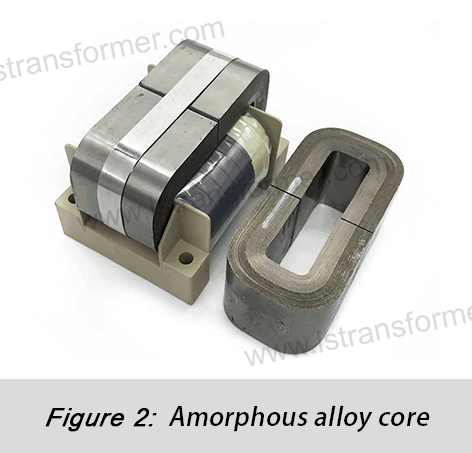
3.1 Historical Background:
In 1976, AlliedSignal (USA) mass-produced iron-based amorphous alloys (Fe80B10Si10) using rapid solidification technology (cooling rate: 10⁶°C/s). Its disordered atomic structure broke the electromagnetic performance limits of traditional crystalline materials.
3.2 Advantages:
The amorphous structure eliminates grain boundary resistance to magnetic domain movement, reducing hysteresis loss to 1/4 that of silicon steel (P1.3/50≈0.2 W/kg). High resistivity (1.3 μΩ·m) cuts eddy current losses by 80% compared to silicon steel. Amorphous alloy transformers reduce no-load losses by 70%, saving 1,500 kWh annually (for a 500kVA transformer). The U.S. DOE classifies them as “ultra-high efficiency” (≥99.5%).
3.3 Disadvantages:
Amorphous alloy ribbons are extremely thin (25μm) and mechanically brittle, leading to fractures during processing (yield rate: 70%-80%). Initial costs are 2-3 times higher than silicon steel, and recycling is difficult (requires high-temperature remelting, increasing energy use by 30%).
3.4 Applications:
Distribution transformers (mandated by the EU Ecodesign Directive).
High-efficiency filtering in PV inverters and wind power converters.
3.5 Optimization Measures:
(1)Composite designs:Coating amorphous ribbons with epoxy resin and fiberglass layers (0.1mm thickglass layers (0.1mm thick) increases bending strength by 300%, solving brittleness.
(2)Twin-roll continuous casting boosts production speed from 20 m/min to 100 m/min, reducing costs to 1.5× silicon steel.
4. Future Materials: Nanocrystalline Alloys and Ultra-Low-Loss Silicon Steel

Post-2010, Japan’s TDK developed nanocrystalline alloys (Fe-Si-B-Cu-Nb) with core losses as low as 0.1 W/kg (1.5T@50Hz) and permeability >10,000 at 1MHz (vs. 5,000 for amorphous alloys). Precise annealing (500°C±5°C) controls grain size below 20nm, preventing magnetic degradation. However, production requires ultra-high vacuum (<10⁻⁵Pa), with equipment costs 10× higher than silicon steel lines, driving prices to 5-8× silicon steel. The 20μm thickness also complicates winding processes.
Core Material Comparison Table
| 財産 | シリコン鋼 | CRGO | アモルファス合金 | ナノ結晶合金 |
| Key Applications | Grid retrofits, reactors | HVDC, offshore wind | Smart grids, solar PV | 5G, EV fast charging |
| コアの活用 | Low cost, mature | High permeability | Ultra-low no-load loss | High-frequency performance |
| Main Drawback | Localized heating | Insulation risks | Brittleness, recycling | Extreme cost, complexity |
| 規格 | IEC 60404-8-2 | IEC 60404-8-3 | IEC 60404-8-7 | IEC 60404-8-8 (draft) |
概要
From silicon steel to amorphous alloys, each breakthrough in core materials has profoundly impacted power industry efficiency. The IEA predicts that by 2030, amorphous alloys will dominate 60% of the global distribution transformer market, cutting CO₂ by 500 million tons annually. Meanwhile, nanocrystalline alloys unlock new potential for high-frequency power electronics. This silent material revolution is a cornerstone of humanity’s carbon-neutral future.
For core material whitepapers or custom solutions, visit our international site to schedule an engineer consultation.
連絡先
廬山,est。 1975年には中国の専門職の専門メーカーの電力変圧器及び原子炉のための50+る。 主製品 単相トランス、三相絶縁変圧器、電気トランス、物流トランス、ステップの下、信用リスク以外のリスクにつきトランス、低電圧トランス、高電圧トランス、制御トランス、トロイダルトランス、Rコアトランス直流インダクター、AC炉では、フィルタリング炉、負荷炉chokes、フィルタリングの原子炉は、中間体、高周波製品.
当社の電力変圧器及び原子炉に広く使用されて10アプリケーション:高速鉄道、建設機械、再生可能エネルギー、ロボット、医療機器、炭鉱爆発の防止、励起システム、真空焼結(炉)、中央エアコンがあります。
知電源トランス原子炉: www.lstransformer.com.
希得のカスタマイズソリューションのためのトランスや原子炉、お問い合わせください。
WhatsApp:+86 13787095096
メール:marketing@hnlsdz.com

