






Transformer Trips Immediately After Power-On: Who’s Causing the Trouble?
Transformer Trips Immediately After Power-On: Who’s Causing the Trouble?
As a transformer operator, you may have encountered this issue: the equipment is newly installed, but it trips instantly during the first power-on. This not only leads to production downtime but may also cause safety hazards. So, what exactly causes this problem? Is it an issue with the transformer itself, or are external factors “causing trouble”?
1. Common Causes of Transformer Tripping
Transformer tripping upon power-on is usually caused by electrical faults, abnormal loads, or malfunctioning protection systems. According to the IEC 60076 standard, transformers are designed with multiple protection mechanisms, and tripping is a normal function of these mechanisms to prevent equipment damage or safety incidents. Below, we break down the main causes in detail.
1.1 Insulation Failure and Short Circuit Issues
Insulation failure is one of the most common reasons for transformer tripping, potentially leading to direct short circuits or ground faults. When transformer windings or insulating materials age, become damp, or suffer mechanical damage, their insulation resistance decreases, causing abnormal currents.
1.1.1 Impact of Insulation Aging
Transformer insulating materials (such as oil-impregnated paper) gradually degrade over long-term operation due to thermal, electrical, and chemical stress. According to the Arrhenius equation, the rate of insulation aging increases exponentially with temperature:
Aging rate ∝ e^(-Ea/kT)
where Ea is the activation energy
k is Boltzmann’s constant
T is the absolute temperature
When the insulation resistance falls below the threshold specified in IEC 60076-3 (typically 1 MΩ), leakage current increases and may trigger overcurrent protection devices, causing a trip. For example, if the transformer is stored in a humid environment, moisture infiltration reduces the dielectric strength of the insulation, leading to an instantaneous short circuit during power-on.
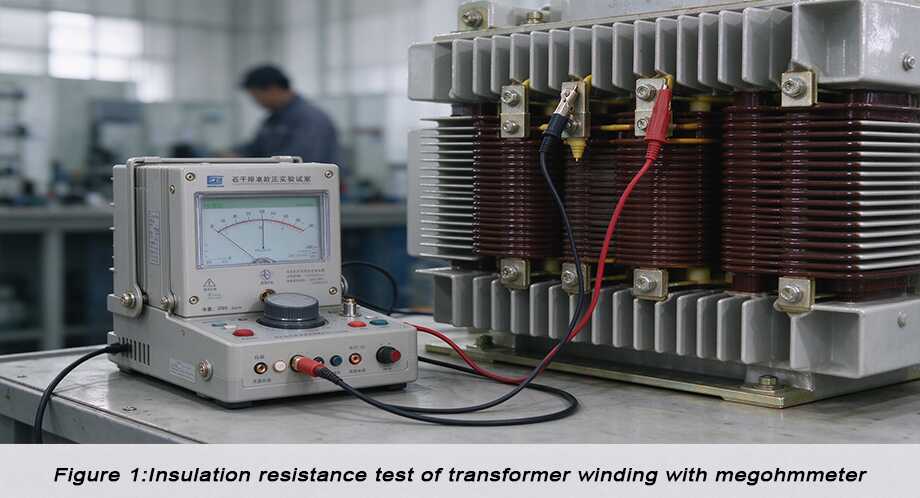
Solution: Conduct regular insulation resistance tests (e.g., using a megohmmeter) and ensure the transformer is stored in a dry environment. This approach is effective because testing can detect insulation degradation early, while a dry environment slows moisture penetration, maintaining insulation performance.
1.1.2 External Short Circuit or Overload
Short circuits in external circuits or sudden load increases can cause a sharp rise in current, exceeding the transformer’s rated capacity. According to Ohm’s Law:
I = V / Z
When load impedance Z suddenly decreases (e.g., during a short circuit where Z → 0), current I tends toward infinity, triggering overcurrent protection. Common scenarios include downstream equipment failures or wiring errors.
Solution: Install circuit breakers or fuses and calibrate the settings of protection devices. These measures are effective because breakers can quickly cut off the circuit when current exceeds limits, preventing transformer overheating and damage.
1.2 Protection System Malfunctions
Transformer protection systems (such as differential protection and overtemperature protection) may malfunction due to improper settings or interference, leading to unnecessary tripping.
1.2.1 Differential Protection Malfunction
Differential protection detects internal faults by comparing the input and output currents of the transformer. If current transformers (CTs) are wired incorrectly or have mismatched ratios, the balance current is distorted, causing a false trip.
Solution: Calibrate CT parameters and check wiring polarity. This measure is effective because ensuring accurate current signals prevents the protection system from misjudging faults.
1.2.2 Overtemperature Protection Activation
Transformer overheating may result from cooling system failures or excessive ambient temperatures. Overtemperature protection devices (such as thermal relays) automatically trip when winding temperatures exceed the safe threshold (typically 150°C).
Solution: Check the operation of cooling fans or oil pumps and improve ventilation conditions. This is effective because restoring the cooling system reduces temperature rise and avoids thermal breakdown of insulation.
2. Diagnosis and Troubleshooting Steps
To quickly identify the cause of tripping, a systematic diagnostic process is recommended. The table below summarizes common fault types and corresponding measures:
| Тип неисправности | Возможные причины | Diagnostic Tools | Решение |
| Insulation Fault | Dampness, Aging | Megohmmeter, Dielectric Loss Tester | Drying Treatment, Replace Insulation |
| External Short Circuit | Load Fault, Wiring Error | Clamp Meter, Circuit Breaker | Inspect Downstream Circuits, Rewire |
| Protection Malfunction | CT Setting Error, High Temperature | Protection Relay Calibrator | Recalibrate Protection, Improve Cooling |
2.1 Preventive Measures Before Power-On
Cuivre vs Aluminium Enroulement de Transformateurs: les principales Différences au-Delà de Coût - LS transformateur de puissance, réacteur de Ligne à Haute tension transformateur d'Huile de transformateur immergé-CHANGSHA LUSHAN ELECTRONIC TECHNOLOGY CO.,LTD Cuivre vs Aluminium Transformateur à Enroulements: 60% de la Conductivité de l'Écart, de Connexion de la Maintenance et de l'Égalité-l'Efficacité des Dessins
Conductivité du cuivre est d'environ 60% de plus que l'aluminium; aluminium à ~61% IACS nécessite environ 60% plus grande section transversale, à performances équivalentes. Mais l'égalité de l'efficacité est réalisable: tout en aluminium, de cuivre et de cuivre primaire/aluminium-secondaire dessins peuvent atteindre 99.53%. Les vrais facteurs de différenciation sont la maintenance des connexions en oxygène portant des environnements, de la résistance mécanique et de court-circuit comportement—pas une couverture écart de rendement. Ce guide sépare le génie de différences à partir de l'argument du coût. Cuivre vs Aluminium Enroulement de Transformateurs: les principales Différences au-Delà des Coûts
> Cuivre vs Aluminium Enroulement de Transformateurs: les principales Différences au-Delà des Coûts Gradually increase the load to avoid sudden full-load application. This is because gradual power-on allows the transformer and circuit to transition smoothly, reducing current surges.
Dans la puissance globale de l'infrastructure et des applications industrielles, les transformateurs sont des équipements critiques où la performance et la fiabilité sont primordiales. Le choix entre le cuivre de la plaie et de l'aluminium de la plaie transformateurs présente souvent un dilemme pour les ingénieurs, l'approvisionnement des décideurs et des planificateurs du projet. Cette décision est bien plus qu'une simple comparaison des coûts; il s'agit d'une évaluation globale de l'efficacité, du service de la vie, de la fiabilité et du total de la valeur du cycle de vie. Ce guide explore les différences fondamentales entre les deux matériaux, pour vous aider à faire un choix qui s'aligne sur les normes internationales et les avantages à long terme—parfait pour votre transformateur guide de sélection. 1. De la conductivité et de l'Efficacité Énergétique: Une Différence Fondamentale
Заключение
Bobinage en cuivre offre exceptionnelle conductivité électrique.
Контакты
Компания LuShan, основанная в 1975 году, является китайским профессиональным производителем, специализирующимся на силовых трансформаторах и реакторах более 50 лет. Ведущими продуктами являются однофазный трансформатор, трехфазные изолирующие трансформаторы, электрический трансформатор, распределительный трансформатор, понижающий и повышающий трансформаторы, низковольтный трансформатор, высоковольтный трансформатор, управляющий трансформатор, тороидальный трансформатор, R-образный трансформатор; катушки индуктивности постоянного тока, реакторы переменного тока, фильтрующий реактор, линейный и нагрузочный реакторы, дроссели, фильтрующий реактор и промежуточные высокочастотные продукты.
Наши силовые трансформаторы и реакторы широко используются в 10 областях применения: скоростной транспорт, строительная техника, возобновляемые источники энергии, интеллектуальное производство, медицинское оборудование, предотвращение взрывов в угольных шахтах, системы возбуждения, вакуумные печи спекания, центральное кондиционирование воздуха.
Узнайте больше о силовом трансформаторе и реакторе: www.lstransformer.com.
Если вы хотите получить индивидуальные решения для трансформаторов или реакторов, пожалуйста, свяжитесь с нами.
WhatsApp: +86 13787095096
Электронная почта: marketing@hnlsdz.com

