





Why Transformers Need Impregnation?
Why Transformers Need Impregnation?
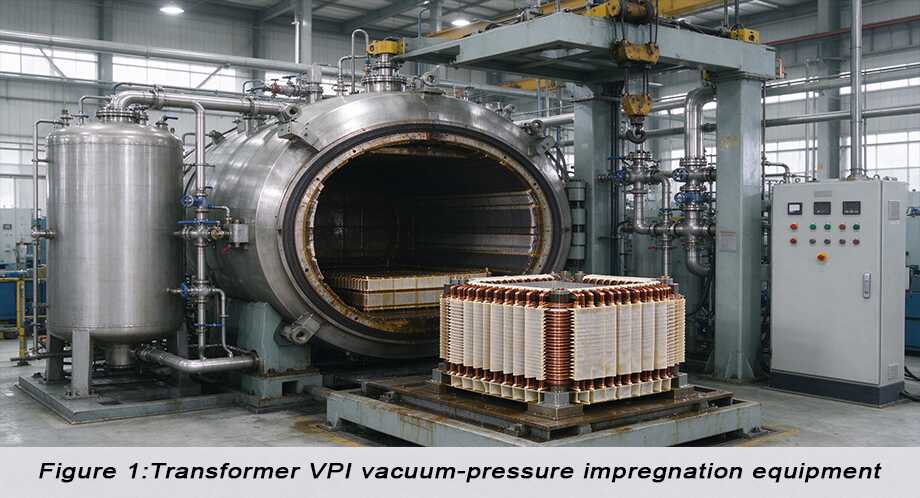
For large power transformers, reactors, and high-frequency transformers, “impregnation” is not just a simple surface treatment—it is a critical manufacturing process for the insulation system. This article delves into the necessity of transformer impregnation and provides a detailed explanation of the Vacuum Pressure Impregnation (VPI) process widely used in modern industry.
1. Why Must Transformers Undergo Impregnation Treatment?
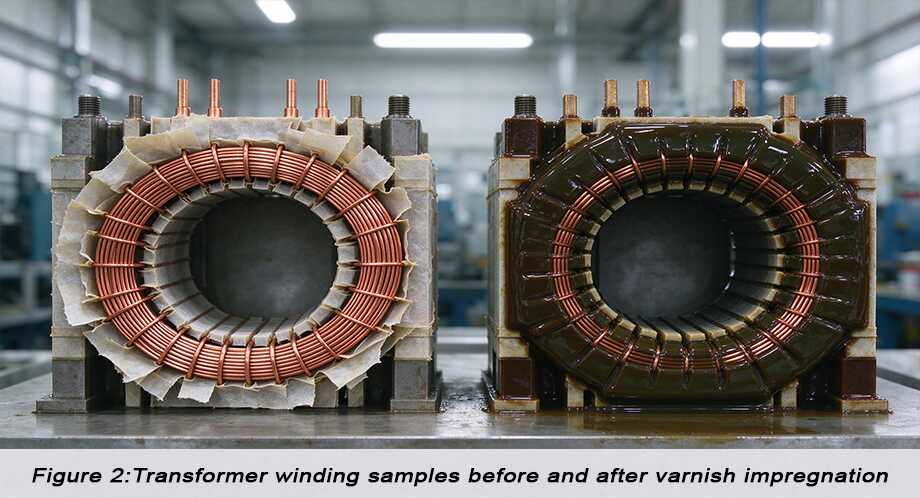
Transformers face multiple stresses during operation—electrical, thermal, mechanical, and environmental. In windings without impregnation, conductors, layers, and the windings themselves are mainly isolated by air and solid insulating materials. However, air has poor insulating properties (low dielectric strength) and is easily affected by humidity and contaminants, making it a weak point in the insulation system. The fundamental purpose of impregnation is to replace or fill these air gaps with insulating varnish, which has excellent electrical, mechanical, and chemical properties, thereby building a robust and integrated insulation system.
1.1 Core Objectives and Cause-Effect Relationships of Impregnation Treatment
Impregnation aims to achieve the following four core objectives, with direct physical and chemical cause-effect relationships between the measures and their results.
1.1.1 Enhancing Electrical Insulation Strength and Partial Discharge Protection
(1)Root Cause:
Conductor surfaces in windings have microscopic burrs, and there are uneven air gaps between turns and layers. Under high-voltage electric fields, the distribution of the electric field within these air gaps becomes highly distorted. Air has a low dielectric constant and a much lower breakdown field strength compared to solid insulating materials. This leads to localized electric field concentration, which initially triggers partial discharge. Although partial discharge is weak, it continuously erodes the surrounding insulating materials. Over time, this causes insulation aging and carbonization, eventually leading to insulation breakdown.
(2)Solution (Impregnation):
Through impregnation, low-viscosity insulating varnish penetrates into the smallest gaps of the winding under vacuum and pressure conditions, completely displacing the air.
1.1.2 Improving Heat Dissipation and Thermal Management
(1)Root Cause:
Copper losses and iron losses during transformer operation generate heat. Air has very poor thermal conductivity, making it difficult for heat within the windings to be effectively transferred to external radiators or the oil tank. This results in increased hotspot temperatures. According to the Arrhenius Law, the aging rate of insulating materials increases exponentially with temperature—for every 8-10°C rise in temperature, the insulation lifespan is roughly halved.
(2)Solution (Impregnation):
Using insulating varnish to fill the gaps. Although cured insulating varnish is a poor thermal conductor, its thermal conductivity (approximately 0.2-0.3 W/m·K) is still an order of magnitude higher than that of air. This helps establish efficient heat conduction paths.
1.1.3 Increasing Mechanical Strength and Vibration Resistance
(1)Root Cause:
Transformers, especially power transformers, are subjected to mechanical stresses caused by electromagnetic forces and physical vibrations (e.g., from the installation environment). Loosely structured windings may experience minor displacements and friction under alternating electromagnetic forces, leading to long-term insulation wear, conductor deformation, or even breakage.
(2)Solution (Impregnation):
After curing, the insulating varnish bonds the wires, insulating materials, and framework into a solid, rigid whole—essentially creating a structural adhesive bond. The cured varnish film provides strong adhesive force, locking all components in place. This allows the entire winding to function like a solid block of “concrete,” significantly enhancing its vibration resistance and ability to withstand short-circuit electromagnetic forces.
1.1.4 Providing Excellent Moisture, Corrosion, and Environmental Protection
(1)Root Cause:
Moisture, salt spray, chemical pollutants, and oxygen from the environment can penetrate the winding. Moisture reduces the volume resistivity of insulating materials, increases dielectric loss, and accelerates hydrolytic aging. Pollutants can form conductive paths or corrode metal conductors.
(2)Solution (Impregnation):
The cured varnish film forms a continuous, non-porous barrier on the winding surface and within internal gaps. This barrier effectively blocks the penetration of external moisture, gases, and pollutants. It also isolates the winding interior from the external environment, preventing potential cross-contamination and ensuring the long-term stability of the insulation system under various harsh conditions.
| Показатель производительности | Non-Impregnated Winding | Vacuum Pressure Impregnated Winding | Key Reason for Improvement |
| Partial Discharge Inception Voltage | Низкий | Significantly Increased (possibly by over 50%) | Elimination of air gaps, homogenization of electric field |
| Thermal Conduction Efficiency | Low (relies on air convection) | Высокий | Establishment of solid heat conduction paths, increased contact area |
| Short-Circuit Mechanical Strength | Weak, prone to deformation | Very Strong, monolithic rigidity | Structural bonding formed by cured varnish film |
| Moisture Resistance (Moisture Absorption Rate) | Высокий | Очень Низкий | Formation of a dense, continuous sealing protective layer |
| Ожидаемый Срок службы | Shorter, highly influenced by environment | Long, stable, and reliable | Combination of all above factors, slowing insulation aging |
Заключение
Transformer impregnation, especially using the Vacuum Pressure Impregnation (VPI) process, is by no means a dispensable step—it is the cornerstone of building long-term operational reliability. Through a precisely controlled physical process, it transforms liquid insulating material into a solid internal insulation skeleton and protective armor for the windings. This fundamentally enhances the transformer’s electrical strength, heat dissipation capability, mechanical stability, and environmental adaptability. For manufacturers and users of transformers and reactors who pursue high quality and reliability, understanding and valuing the VPI process is key to ensuring the stable and efficient operation of power and electronic systems.
Контакты
Компания LuShan, основанная в 1975 году, является китайским профессиональным производителем, специализирующимся на силовых трансформаторах и реакторах более 50 лет. Ведущими продуктами являются однофазный трансформатор, трехфазные изолирующие трансформаторы, электрический трансформатор, распределительный трансформатор, понижающий и повышающий трансформаторы, низковольтный трансформатор, высоковольтный трансформатор, управляющий трансформатор, тороидальный трансформатор, R-образный трансформатор; катушки индуктивности постоянного тока, реакторы переменного тока, фильтрующий реактор, линейный и нагрузочный реакторы, дроссели, фильтрующий реактор и промежуточные высокочастотные продукты.
Наши силовые трансформаторы и реакторы широко используются в 10 областях применения: скоростной транспорт, строительная техника, возобновляемые источники энергии, интеллектуальное производство, медицинское оборудование, предотвращение взрывов в угольных шахтах, системы возбуждения, вакуумные печи спекания, центральное кондиционирование воздуха.
Узнайте больше о силовом трансформаторе и реакторе: www.lstransformer.com.
Если вы хотите получить индивидуальные решения для трансформаторов или реакторов, пожалуйста, свяжитесь с нами.
WhatsApp: +86 13787095096
Электронная почта: marketing@hnlsdz.com